
Why Kevin Yoder of Infinite U and Yoder Real Estate Stopped Recruiting and Built a More Profitable Team
By Shaune Corbett·
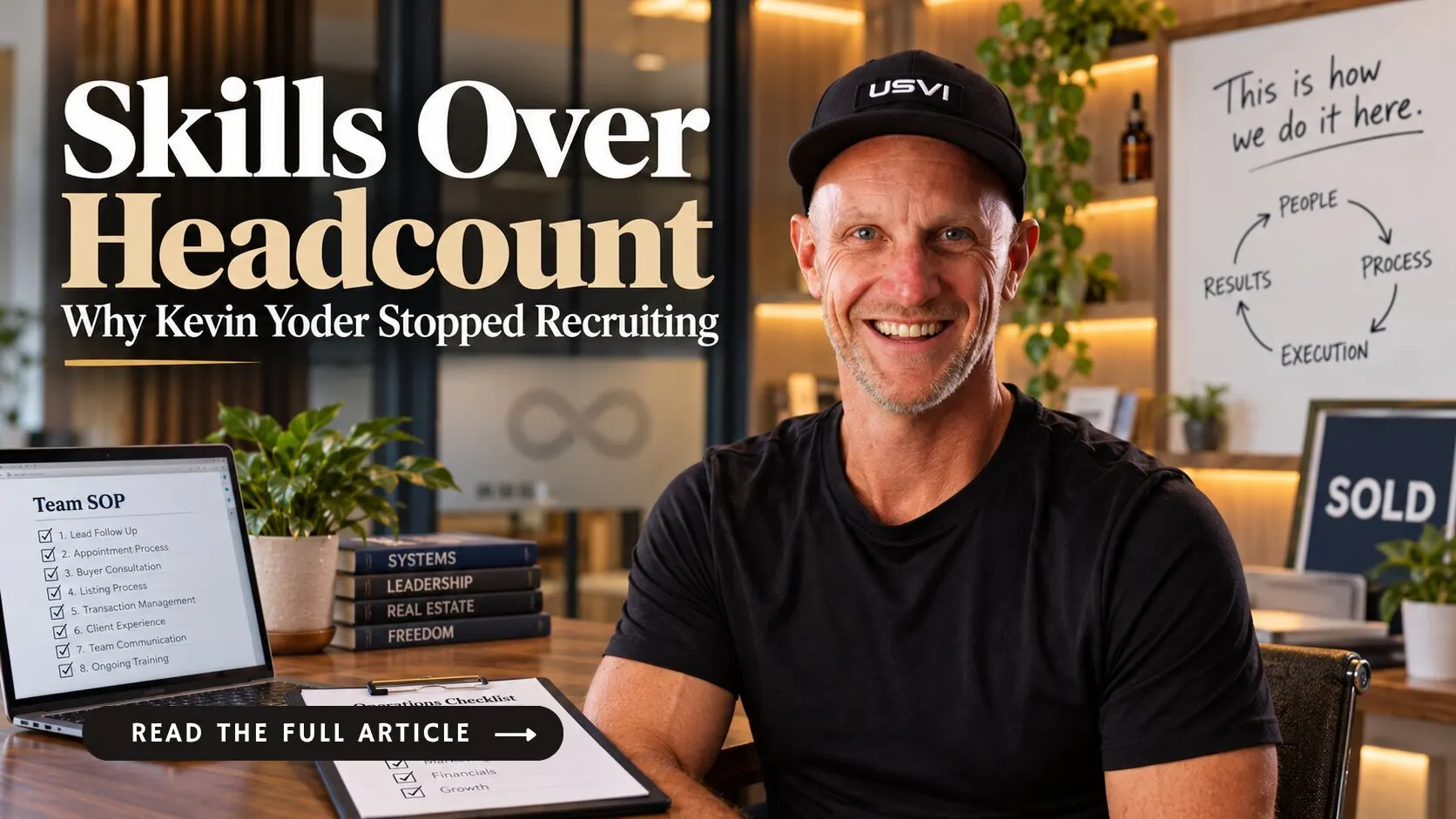
More leads and a bigger team won’t make your real estate business more profitable. Sharper sales skills and documented systems will.
That was the big idea when I sat down with Kevin Yoder of Infinite U and Yoder Real Estate on Real Estate Success DFW. Kevin has 26 years in the business. His two-agent team outproduced his six-agent team, and he recently stopped recruiting altogether.
Here’s how he turns experience into SOPs, uses AI as a second brain, and builds skill before spending on leads.
Curious why Kevin walked away from recruiting? Here’s a quick preview of our conversation:
The Growth Advice That Keeps Real Estate Agents Stuck
The standard advice never changes. Buy more leads. Add more agents. Let volume fix the rest. I’ve watched that bet fail too many times.
During COVID, business got explosive. I sold 127 houses, about $40 million, with just me and my admin. Busy didn’t mean I needed a bigger team. It meant I needed better systems.
That’s why I wanted Kevin on the show. He built one of the top-performing teams in the Midwest. He has coached hundreds of salespeople. And after 26 years, he’s still in active production. He leads his own real estate team and created a self-image coaching methodology called Infinite U.
One line from Kevin set the tone for the whole episode. Stop wishing the leads were easier. Become the agent who can convert the hard ones.
Watch the full episode here:
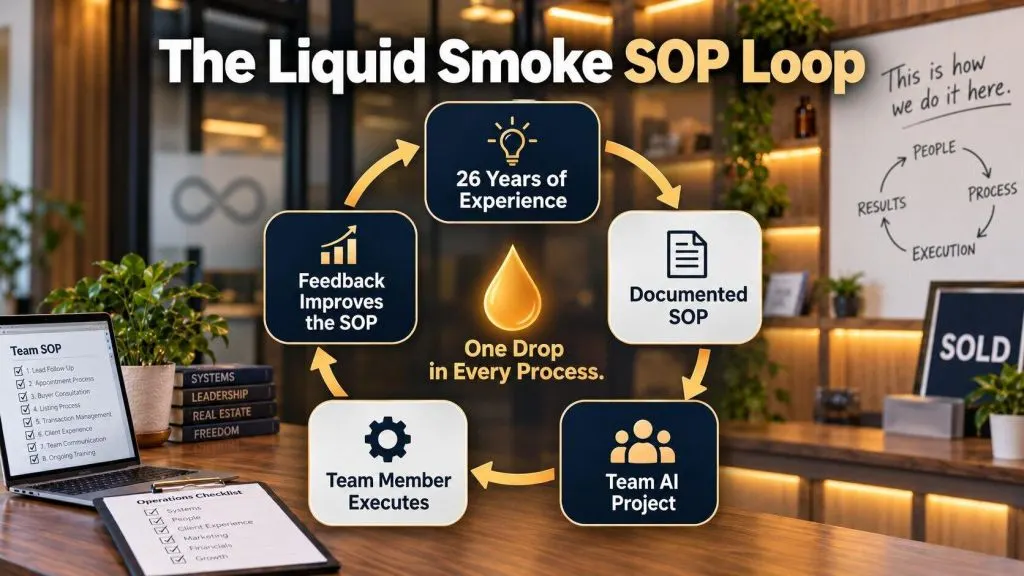
Liquid Smoke: How Kevin Puts His Judgment Into Every SOP
Kevin is rebuilding his team around an idea he calls liquid smoke. If you grill, you know it. One drop of that concentrate makes the whole dish taste smoked.
His goal is one drop of himself in every process. Every SOP, every system, every strategy. When one team member handles a task, it should match how every other team member handles it. And each person is expected to improve the system with every transaction, not run it like a robot.
Kevin was honest about why this matters to him. Years ago, he ran a brokerage of about ten agents and let everyone work however they wanted. Looking back, he sees how much opportunity that freedom cost his clients.
His method for building real estate team SOPs takes discipline. When you do something that isn’t documented yet, slow down. Record it. Turn it into an SOP. Then listen for one word.
“There’s a word that I teach my team never to use, any word ending in ‘-ly’ as it relates to how we do things here. And I don’t mean ‘delightfully.’ I mean the word ‘usually.’ The kiss of death for any business is ‘usually.’ Whenever you hear someone say, ‘How do you do this here?’ and the answer is ‘Well, usually we…’ right there, that’s a strong indicator you don’t have a solid system in place that says this is how we do it here, every single time. And the standard changes from one client experience to the next. The Joneses get this experience, the Smiths get that one, and those Google reviews are spotty. They’re haphazard.”
Kevin Yoder
Kevin compared it to the fry station at McDonald’s. The fries stay in the oil for the exact prescribed time, with no deviation. That’s why they taste the same in every city.
I see the opposite all the time. Agents want a real estate team that runs without the owner, but they never write down how they work. Consistent service is what creates consistent reviews, and I believe reviews are our real currency, not commissions. Kevin also offers coaching built for real estate teams that want to close this gap.
The “What Would Kevin Do” GPT: An AI Second Brain for Your Team
Once an SOP exists, Kevin uploads it into a custom GPT project that works as an AI second brain for real estate teams. His team calls it the Yoder Project. If Kevin is on stage, traveling, or in a cabin with no signal, his agents ask the project what Kevin would do.
The guardrails make it work. The project doesn’t improvise. It pulls from documented doctrine covering inspection negotiations, pricing models, and property types from entry-level homes to duplexes, multifamily, and land. Kevin also built in what he calls “the things between the things.” Those are the negotiation cues no textbook teaches, and he says they’re worth millions in client savings.
Then he said something I didn’t expect. In many ways, the project is better than him. It’s never tired. It’s never rushed. We’ve all given a team member a fast answer under pressure and regretted it the next morning.
Agents are catching on to AI, but most are using it for smaller jobs. NAR’s 2026 REALTORS® Technology Report found that 23% of Realtors use AI daily and 55% say it has helped their business. Writing listing descriptions is still the top use. Kevin uses it to scale his judgment. That’s a different game entirely. I post often about AI and real estate team systems because I think this is where the next edge is.
Two Agents Outproduced Six: The Case for a Leaner Real Estate Team
Kevin’s best year came with one agent and one administrator. He ran at roughly 39% profitability, a level of real estate team profitability most owners never reach. Most brokerages sit around 10 to 15%, maybe 20 in a great year. Kevin was blunt. He isn’t doing all this for 10 or 15%.
Here’s the part that surprised me. Last year, his two agents beat what six agents had produced. Headcount was never the point.
Busy isn’t a reason to hire either. Ten closings this month can become three next month. Kevin learned that the hard way. About ten years ago, he rushed to get out of production. He brought in a listing partner while running at about 25% profitability, then paid that partner 25%. The margin vanished overnight. He had also stepped out of production too early.
Now he studies 12 to 24 months of numbers, seasonality included, before adding payroll. He also says you get to decide what size business you want. Locking in at 80 to 100 units a year and staying profitable is a legitimate choice, no matter who tells you that you need 200.
We both called out the two growth models that fail most often. One recruits as many agents as possible and hopes a few produce. The other buys leads to keep a bloated roster from leaving. I’ve seen the same pattern in other conversations about paid leads and smart delegation. Growth should follow demand. It should never come first.
Why Kevin Stopped Recruiting and Bet on Showing Specialists
This is the moment that opened the episode. Kevin spent the last four years building Infinite U. Natural attrition shrank his team, and he chose not to replace those agents. He stopped recruiting. And he says he’s good.
His reasoning comes down to leverage. Kevin isn’t convinced the traditional buyer-agent model is sound. He doubts today’s model survives the next three years. What he does know is that a listing-heavy model is extremely profitable. You can sell homes with your feet in the sand on a Caribbean beach. You can’t do that while driving buyers around town.
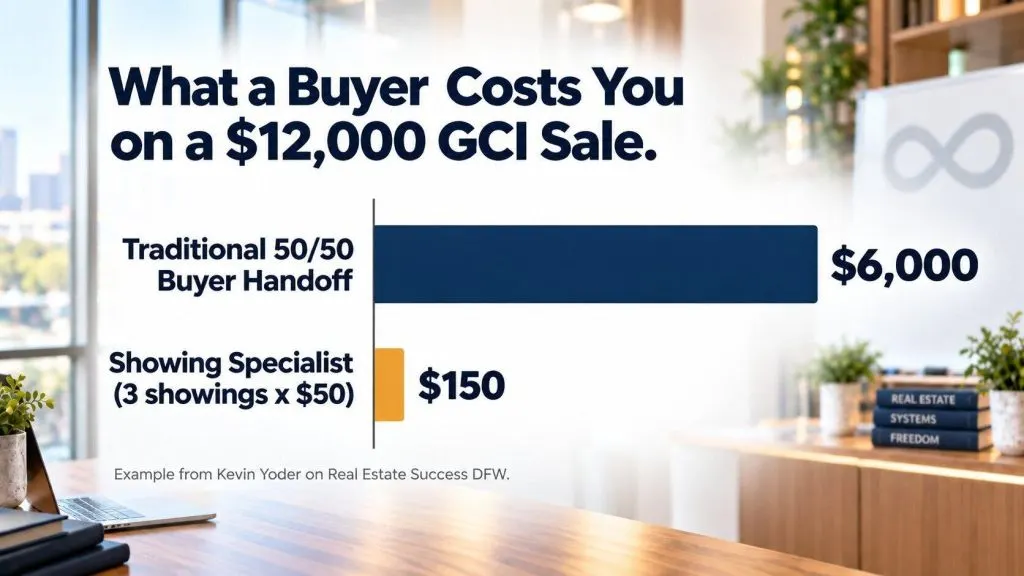
He ran the math on the showing specialist model for me. On a sale that produces $12,000 in GCI, a quick 50/50 buyer handoff gives away $6,000. A showing specialist paid $50 a door; three showings cost $150. That gap is the whole argument.
Today his setup is lean. Kevin is the lead agent. He has an executive assistant working 20 hours a week and a full-time VA. Photography, drone, and video editing are outsourced. Showing specialists handle buyers, including sellers who go on to buy their next home. His next hire will likely be an in-house showing specialist, then a buy-side agent. Neither will be on a traditional 50/50 split.
Kevin asked a fair question. In what other sales world does the salesperson keep half the revenue? He has sold in telecom and security, and he says most sales roles earn closer to 10%. The rules are already shifting, too. The practice changes from the NAR settlement that ended offers of compensation on the MLS and now requires a written agreement between buyers and their agents.
I told Kevin where I think this goes. AI will automate much of the contract process and even showings. The result will be fewer agents selling more houses for less commission, whether we like it or not. His model is built for that future, and he shares more of his thinking on real estate leadership and team building regularly.
The Lead Ladder: Why Sales Skill Has to Come Before Lead Spend
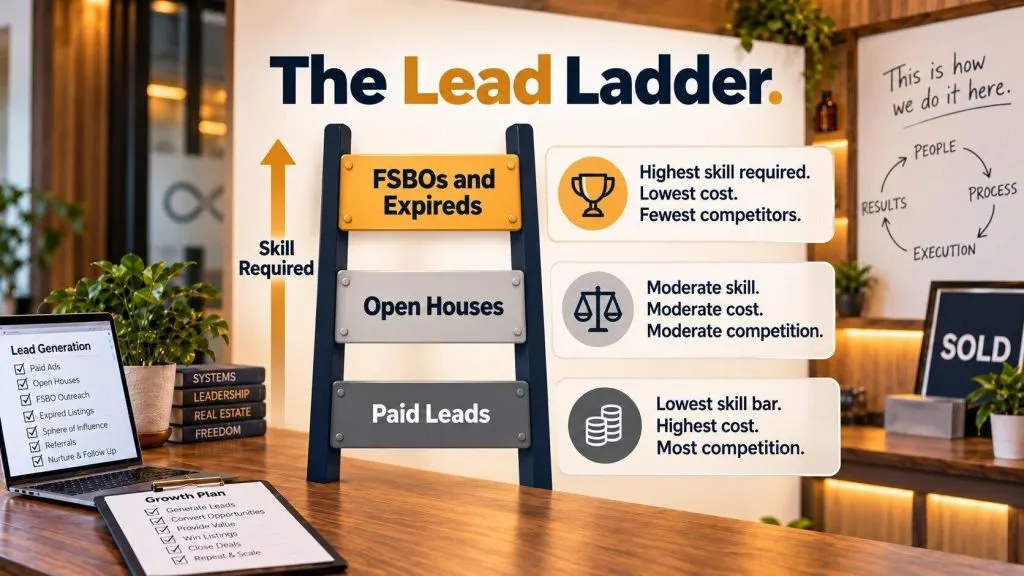
Kevin described lead sources as a ladder. At the top sit FSBOs and expireds. They demand the highest skill, cost the least, and draw the fewest competitors. Open houses sit further down. Paid leads sit at the bottom. They’re the most expensive, the most crowded, and require the least skill.
Most agents cluster at the bottom and pay the most to fight everyone else. Kevin isn’t telling every agent to buy a dialer, and he admits he doesn’t enjoy those calls either. His point is bigger, and it settles the sales skills vs. paid leads debate. The ability to talk with a stranger and influence them to act is the skill that makes every other lead source easier.
He tied this to Albert E.N. Gray’s classic speech, “The Common Denominator of Success.” Gray found that successful people form the habit of doing what unsuccessful people are unwilling to do. They don’t have to like the activity. They connect it to the result they want. For Kevin, the calls aren’t fun. Seeing his sign in a yard and his client at the closing table is.
Then came the story that stuck with me. In 2011, Kevin mailed a $5,000 check to a company that would call FSBOs and expireds and book appointments for him. He proudly told his coach. The coach went silent. Then he asked which choice would make Kevin a better leader and trainer in two or three years. Outsourcing the most valuable skill in the business, or mastering it and teaching it? Kevin canceled the check, bought a dialer, and started calling.
That choice earned him credibility. Nobody on his team can say, “You had a call center, so why are we dialing?” If you can convert the hardest conversations, the easier ones take care of themselves. I share lessons like this about prospecting and real estate sales skills with agents all the time.
How to Handle Rejection Without Making It Personal
Two agents can hear the same “no.” One decides they’re bad at this. The other says, “Good, I just got another rep.” Kevin says the difference is self-image, which sits at the heart of his Infinite U work.
“The way I look at it is, don’t wish it was easier, make yourself better. Because if I can’t influence you, Shaune, to meet with me, I simply have not engaged in the psychology required for you to buy into it. If there’s a circumference around the person and I came in from the right side and it wasn’t a connection, I’ll move around to the other side, and I’ll continue to do that until I find a way to connect that resonates with the individual. It is our job to identify the psychology, the six inches between the prospect’s ears, and then get into resonance with them as quickly as possible through a process of asking better questions.”
Kevin Yoder
There’s a big gap between thinking “I failed” and believing “I am a failure.” A strong self-image treats a hang-up as feedback. What question could I have asked better? Was I rushing? Kevin teaches his agents to ask those questions after every lost call. If you want to see where your own patterns hold you back, his free self-image assessment is a smart place to start.
I shared something I’ve only learned in the last six months. Stop being attached to the outcome. Kevin agreed, with one filter. Attachment hurts most when you operate from lack. If losing one seller wrecks your week, you weren’t talking to seven others at the same time. That’s on you.
He also warned against the opposite mistake. “Not attached” can’t become an excuse for aimless calls. Every sales conversation has a beginning, a middle, and an end. You need the self-awareness to notice when you drift off that line. Staying in the game long enough to get good matters too, which is why quitting too soon costs agents more than any single rejection ever will. Kevin posts short reminders on mindset and sales performance that are worth following.
Standards Beat Motivation, and Clients Pay When They’re Missing
Agents rarely have a knowledge problem. Kevin says they have a standards problem. Inspiration gets people into real estate. A show, a video, a podcast. What keeps them going is a clear, documented motive. That motive builds standards that hold up even on days you don’t feel like working.
His example was simple. Most agents have a checklist. But it might hold ten items when it needs a hundred. They submit an offer, check one box, and miss the blanks that make it complete. For Kevin, this is about integrity. Do it right or don’t do it. That’s also why the boring basics build a real estate career more than any shortcut does.
We also talked about the lifestyle agent. I used to call it the social club agent. They drive the nice car and close a handful of deals a year. I cited a typical income around $58,000 during our talk, and NAR’s 2026 Member Profile now puts the median gross income for Realtors at $59,200.
Kevin’s concern is the client. An agent who hasn’t closed a deal in 30 days is a surgeon who isn’t doing surgery. A seller can’t tell whether 97% of list price was a win or 4% left on the table. They just think it went great because it sold in 30 days. Kevin shares more of his views on high standards in real estate with his community.
What Kevin’s Approach Changed in How I Build My Business
One moment from our talk keeps coming back to me. Kevin admitted what used to drive his growth.
“I was building a team based on vanity. There’s a lot of people around, a lot of people, and I feel good about this. And yet you pull back the production numbers, and what we accomplished last year with two agents exceeded what I had done with six. So the numbers are proof positive that it’s not just about headcount. It’s about each individual leaving the organization better than they found it, and vice versa. It needs to be a mutually beneficial relationship.”
Kevin Yoder
That reframed growth for me. Too many owners spend 30 or 40 years building something nobody will buy, because it’s worthless without them. A team that runs on documented systems is a business. A team that runs on one personality is a job.
Now I look at every growth decision through Kevin’s lens. Does this hire improve the client experience, or just make the office feel fuller? Is my value strong enough that I set the commission instead of defending it? In the absence of value, price is always negotiable.
Kevin even shared a text from a client the night before our recording. It said they believe in “the Yoder advantage.” That kind of loyalty comes from a system, not luck. If this conversation hit home, his 12-lesson Infinite U coaching program officially launches October 14, 2026. I’ll keep sharing real estate success lessons from Dallas-Fort Worth as we record more conversations like this one.
Want to hear my entire conversation with Kevin Yoder of Infinite U and Yoder Real Estate, where we break down why he stopped recruiting, how he built a 39% profitable team with just two people, and why sales skills beat paid leads every time?
FAQ: Kevin Yoder on Leads, Teams, and Real Estate Systems
Should real estate agents improve their sales skills before buying more leads?
Yes. Kevin believes more leads only create more opportunities. Without strong prospecting, questioning, and conversion skills, agents pay the highest prices in the most crowded lead pool and still struggle to close.
When should a real estate team hire another agent?
Hire when 12 to 24 months of data, including seasonality, show steady demand and your profitability can support the role. One busy month isn’t enough. Paying away a percentage you can’t afford erases your margin.
Is the traditional buyer-agent model still sustainable?
Kevin isn’t convinced it is. He is moving toward a listing-heavy model supported by showing specialists, outsourcing, and AI. In his example, three showings at $50 each cost $150, compared with a $6,000 split.
How can AI help a real estate team?
Kevin uses a custom GPT project built from his SOPs and negotiation insights. His agents can ask it how Kevin would handle a situation at any hour, and it answers within his documented guidelines.
What is Infinite U?
Infinite U is Kevin Yoder’s coaching methodology built on applied self-image. It helps entrepreneurs find and rebuild the internal patterns that cap their performance. It officially launches October 14, 2026.
Never miss an episode
Subscribe to Real Estate Success DFW on your favorite app. Have a story or strategy other agents should hear? Apply to be a guest.
More episodes

The Brokerage Myth I Unpacked With Devin Dubuc of Mortgage Coaching on Loan Officer Success Live
A better split won't fix a slow pipeline. Get the review and follow-up systems shared on Loan Officer Success Live with Devin Dubuc Mortgage Coaching.

What Geoff Cavender of The Cavender Team Knows About Leads That Most Agents Miss
Paid leads rarely fail on their own. Geoff Cavender of The Cavender Team shares the follow-up system and delegation plan behind 450 deals. Learn how.

Jennifer Gale of Gale Group Realty Says Quitting Too Soon Is Costing You Everything
Jennifer Gale of Gale Group Realty reveals how staying consistent turned 19 agents into 70. Discover the systems and mindset shift that make it stick.