
The Brokerage Myth I Unpacked With Devin Dubuc of Mortgage Coaching on Loan Officer Success Live
By Shaune Corbett·

Will a new brokerage fix your business? Almost never.
Every year, thousands of agents chase better splits, better tech, and better training, convinced that switching real estate brokerages will solve everything. After 20 years and over $300 million in sales, I can tell you the broker is rarely the problem. Your habits and systems are.
I made that case on Loan Officer Success Live with the host behind Devin Dubuc from Mortgage Coaching, in a crossover with my own show, Real Estate Success DFW.
Curious about this episode? Here’s a quick preview of our conversation:
The Brokerage Myth That Keeps Productive Agents Stuck
Devin opened with the question every agent has asked at some point. Why do so many of us believe a new broker will save our business?
It usually starts with frustration. You spend a few years at a traditional split brokerage. Your broker stops adding value but still takes 30 to 40 percent of every check. So a flat-fee model starts to look like the answer.
On paper, that math works. In real life, you give up things you never priced in. You lose daily contact with other agents. Training moves online. Nobody sits in your corner to push you. You are completely solo.
Solo worked for me. I started a brokerage out of my garage 20 years ago. No one taught me how to list a house or present to a buyer. I built everything by asking what the consumer would want. But Devin Dubuc put it well. Golf is a solo sport. Almost every other sport gives you teammates and a coach, and most agents need that.
Watch the full video here:
Here’s what I really wanted agents to hear. A new brokerage might change your environment, but it won’t change your habits. It’s like assuming the grass is greener in the next relationship. You still bring yourself along. That’s why I keep coming back to the boring basics that build every real estate career.
The data agrees. NAR’s research on home buyers and sellers has shown for years that most sellers contact just one agent and lean heavily on referrals and past relationships. Clients pick you, not the logo on your sign.
<table><tbody><tr><td><p><span style=“font-weight: 400;”>A New Brokerage Can Change</span></p></td><td><p><span style=“font-weight: 400;”>It Can’t Fix</span></p></td></tr><tr><td><p><span style=“font-weight: 400;”>Your split</span></p></td><td><p><span style=“font-weight: 400;”>Poor follow-up</span></p></td></tr><tr><td><p><span style=“font-weight: 400;”>Your tech stack</span></p></td><td><p><span style=“font-weight: 400;”>Inconsistent processes</span></p></td></tr><tr><td><p><span style=“font-weight: 400;”>Your branding</span></p></td><td><p><span style=“font-weight: 400;”>Lack of discipline</span></p></td></tr><tr><td><p><span style=“font-weight: 400;”>Your lead offers</span></p></td><td><p><span style=“font-weight: 400;”>Where your next 22 deals come from</span></p></td></tr></tbody></table>
Systems, Not Splits, Decide How Far Your Business Scales
Devin asked what agents should look for in a good broker. Proof. Look for real estate agent systems that produce the same result every time.
Most brokers skip this because they sell freedom instead. Freedom sounds great until every client gets a different experience. You can’t scale chaos.
I see the result constantly. The rare solo agent who reaches about $250,000 a year often works 60 to 70 hours a week to stay there. Devin pushed back on the idea that hiring help shrinks your income, and he was right.
“There’s an absolute fallacy in hiring people will cost me more of my profit and I will make less money. That’s what everyone assumes. They look at it as a hundred percent cost and loss. But what happens is that’s one element of a system, and now you can start having continuity. Every time I get a listing, these are the 10 steps I do every time. Every time I get a buyer, here are the five setups to get everything set and organized before we start writing offers. Everything becomes the same every single time. You have to determine what my value proposition is that I’m gonna offer to the buyer or to the seller, and then make sure every transaction offers that as a core element. When you have it set up that way, all of a sudden things start getting a lot faster and easier and more predictable. I don’t have to be like, I forgot to add the home warranty, I forgot to get the pre-inspection before I listed. The clients get better service because they know what to expect, and you can do a lot more transactions because everybody knows what they’re supposed to be doing. If I added a sixty thousand dollar admin and I’m doing fifty transactions a year, all of a sudden I can start doing seventy, eighty transactions a year. And even if my net profitability is the same, I’m working less, and my scalability increases.”
So write down your listing steps and buyer setup steps before you hire anyone. The hire only works when the system already exists. Once it does, you can start building a real estate team that runs without you.
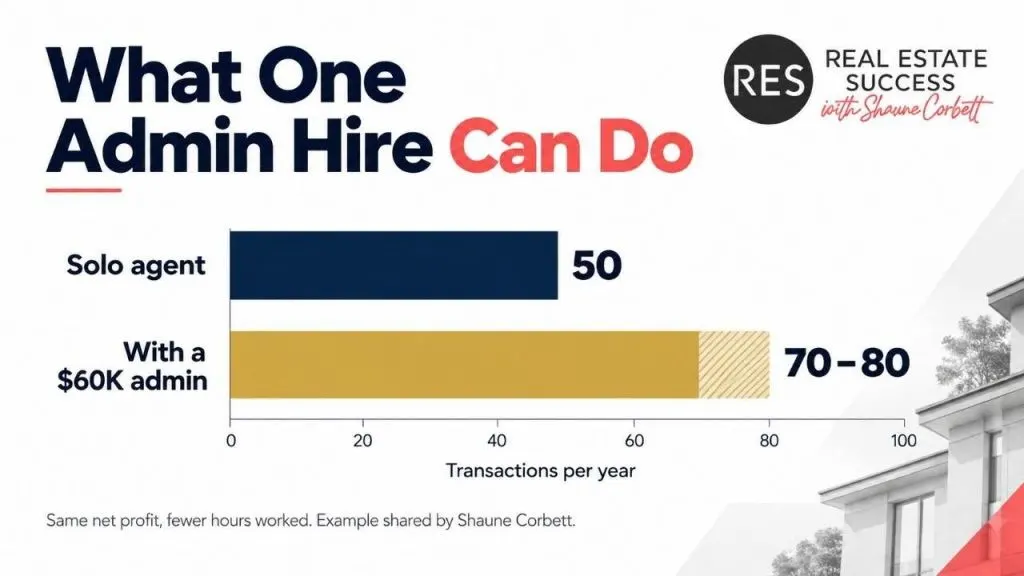
Consistency also builds the asset most agents ignore. Your real currency isn’t commission. It’s five-star reviews. That’s why five-star reviews for realtors carry so much weight. BrightLocal’s Local Consumer Review Survey found that 97 percent of consumers read reviews for local businesses. When someone looks you up and sees a wall of five-star reviews, the decision gets easy.
My Weekly Communication Guarantee and the Five-Star Review System
Next, I asked Devin to guess the number one complaint sellers have about agents. He nailed it right away: communication. After 24 years in mortgage, he has seen that problem from every side. You can follow more of his lending perspective on Instagram.
Most agents never think about it. Sellers don’t either, until they list and their agent disappears for 90 days. So I built a guarantee to make sure that never happens.
“You always have next steps every time you get on the phone call with a client. So if you’re making your weekly calls and you’re talking to your seller: hey, I know we had no showings, here’s the way we’re going to play this out. We’re gonna run two weekends at the current price; we’re gonna make sure the market says no, and when it does, we’re gonna have that conversation about what price would get yeses. One of the things that I recommend is I have a communication guarantee. If I don’t talk to my client every single week, buyer or seller, about updates, then I owe them money. I write them a check. That’s putting my money where my mouth is. And if they ever reach out, buyer or seller, and I don’t communicate with them within twenty-four hours, then I owe them money. I write them a check. All of a sudden, that becomes an important objective for me as an agent. And it’s not about the money. It’s so buyers and sellers know they have a partner.”
Clients can handle hard news when they know the next step. A 30-day reset. A few repairs. A price conversation. What they can’t handle is silence.
That partnership shapes how I ask for reviews, too. I use a gifting program called EvaBot. It asks clients what they love, from coffee to chocolate to tech, then picks a gift that fits them. I set a budget of about $200 to $300. When the gift arrives, I ask for the review. Just yesterday, a buyer sent me a photo of himself enjoying coffee in his new backyard. That’s the moment to ask.

Time Blocking, Business-Day Deadlines, and Ten Database Touches a Day
Devin asked which habits separate agents who produce every year from those who keep starting over. Time blocking for real estate agents tops my list.
Agents have total freedom to chase everything that comes their way. That’s the trap. Most agents I call don’t pick up because they’re scrambling. I tell people they can call me anytime. That’s not because I’m available 24/7. It’s because I’m already ahead.
I’ve also stopped chasing every opportunity. This year I went on six or seven seller appointments with people who loved the pitch but weren’t ready to sell. If the client isn’t ready to decide, I don’t need to be in the room.
Small gains win. Our word of the year was incremental change. I work out at 5 a.m. every weekday and add five push-ups a week, not thirty overnight.
That discipline protects my family time. I have four kids in elementary school, and I don’t show homes on nights or weekends. I set expectations up front. I also never let an option period end on a Saturday. Because the option period in a Texas contract is negotiable, I write deadlines in business days. Nobody wins a 5 p.m. Saturday fight.
Then there’s my database. I reach ten people every day, starting with home anniversaries, then birthdays, then a simple “thinking about you” note. With about 1,500 contacts, I get through everyone about four times a year. When people reply, I send them a magazine cover showing my kids running around our backyard, and just like that, I’m top of mind again. Devin, whom you can connect with on Facebook, shared his own version: divide your database by 13 and reach that many people each week. To go further, here’s how one agent is automating follow-ups to win more buyer deals.

Leading With a Value Proposition Instead of a Resume
Devin asked what my prospecting looks like. I used to lead with my resume: 500 homes sold, over $300 million closed. Clients don’t care. They have a problem, and they want you to solve it. The same goes for agents chasing a bigger split.
“A better split on no business is still no business. It isn’t going to amplify what you’re actually doing. Before blaming the brokerage, you need to identify what the real problem is. If you’re doing eight deals and you want to do 30, the question isn’t who has a better split. The question is where are my next 22 transactions going to come from? And brokers don’t have a real solution for that. They give you shiny objects. Hey, we got leads, because that’s what they all have to lead with. It ain’t gonna get you 22 transactions, I promise you. And no one’s buying a house because the sign says KW or EXP or any of these other brands. That created the lead, but that’s not a strong connection. You have to figure out how to build that strong connection with your audience and then be able to deliver on what that connection is asking you to deliver.”
So build your value around the client’s real problem. Most sellers dread the prep, the showings, and the fear of not selling at all. My company offers programs built around that fear. Not everyone can start there, but any agent can partner with cash buyers and guarantee a cash offer on every home. I bring 14 to 16 offers to every listing appointment. Stop listing, planting a sign, and praying. Solve a problem instead. It’s also why paid leads alone rarely fill a pipeline.
I left with a few lessons of my own. Devin’s “touch the lead, touch the partner” process keeps every side of a loan informed. His tip to speed up Audible will add a few books to my year. You can see more of Devin’s approach to loan officer training. For more conversations like this one, subscribe to Real Estate Success DFW on YouTube.
Want to hear my entire conversation with Devin Dubuc about why a new brokerage rarely fixes a slow pipeline, and what systems actually do? Listen to our podcast episode.
Frequently Asked Questions About Switching Brokerages
Will a better real estate commission split help me grow my real estate business?
Not by itself. A better split on no business is still no business. If you’re doing eight deals and want 30, the real question is where your next 22 transactions will come from. A new broker can’t answer that for you. Your systems, habits, and value proposition can.
Should I join a team or go solo?
If you’re new, a team is a great place to start. You’ll get really good at at least one part of the business. Solo can work, but it’s hard to scale without systems. Most solo agents earning around $250,000 a year are working 60 to 70 hours a week. I’d rather have partners who share the load, even if it means a little less income per deal.
What should I look for in a good broker?
Look for proof. I want to see systems and processes with predictable, repeatable results. If a brokerage sells pure freedom with no process, every client gets a different experience. That makes it impossible to scale.
How do I get more five-star reviews?
Make reviews a natural part of closing. Under-promise and over-deliver on every transaction. I send each client a personalized gift through EvaBot, and I ask for the review right when it arrives. That’s when they feel the best about working with me.
How can I stop clients from controlling my schedule?
Set expectations up front. Tell clients when you show homes, how you communicate, and what happens next at every stage. Write contract deadlines in business days so nothing expires on a Saturday. When clients know your process, they work around your schedule.
How often should I contact my database?
I reach ten people every day, starting with home anniversaries and birthdays, then a simple “thinking about you” message. That keeps me in front of my whole database several times a year. If you’re starting out, Devin’s method works well too: divide your database by 13 and reach that many people each week.
Apply to Be a Podcast Guest on Real Estate Success DFW
My conversation on Loan Officer Success Live with Devin Dubuc of Mortgage Coaching reminded me how much agents gain from hearing what actually works. Splits come and go. Systems last.
If you’re building a real estate business on real processes, whether you sell, lend, inspect, or close, I’d love to hear your story. You can also meet agents like you in the Real Estate Success community, or follow me on Instagram and LinkedIn.
Never miss an episode
Subscribe to Real Estate Success DFW on your favorite app. Have a story or strategy other agents should hear? Apply to be a guest.
More episodes
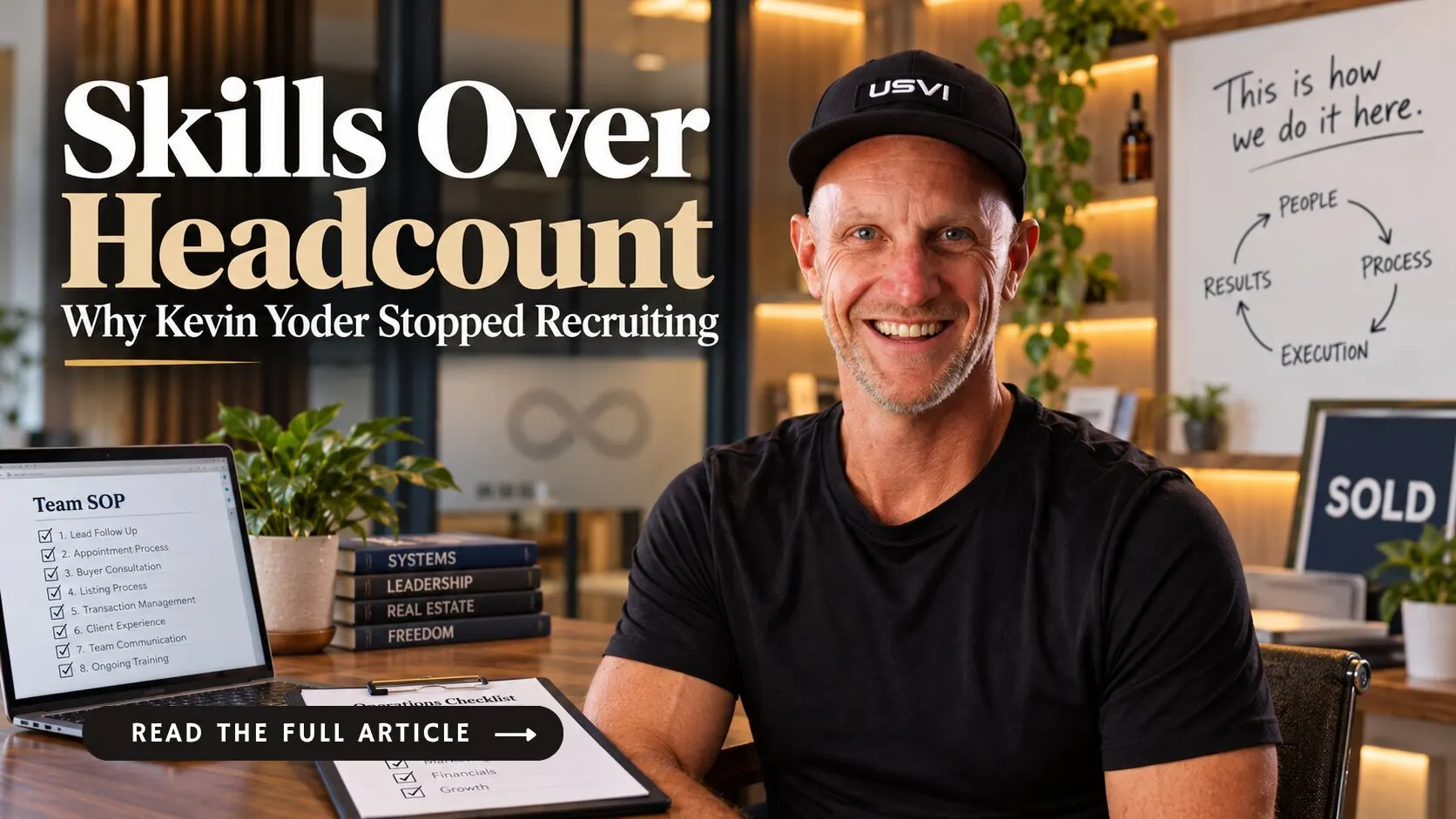
Why Kevin Yoder of Infinite U and Yoder Real Estate Stopped Recruiting and Built a More Profitable Team
Why did Kevin Yoder of Infinite U and Yoder Real Estate stop recruiting? Learn how SOPs, AI, and sharper sales skills beat more leads and bigger teams.

What Geoff Cavender of The Cavender Team Knows About Leads That Most Agents Miss
Paid leads rarely fail on their own. Geoff Cavender of The Cavender Team shares the follow-up system and delegation plan behind 450 deals. Learn how.

Jennifer Gale of Gale Group Realty Says Quitting Too Soon Is Costing You Everything
Jennifer Gale of Gale Group Realty reveals how staying consistent turned 19 agents into 70. Discover the systems and mindset shift that make it stick.