
Why Most Agents Are Overpaid (And How the Top 5% Earn Six Figures): Insights from Jim Bottrell of The Jim Bottrell Real Estate Team
By Shaune Corbett·

A lot of real estate agents are not earning a livable wage. A NAR 2025 Member Trends report showed that the average realtor median gross income was $58,100 in 2024, with a huge percentage of agents having zero deals at all. That gap between activity and actual income is exactly what I wanted to unpack on Real Estate Success DFW, where I had the pleasure of sitting down with Jim Bottrell of The Jim Bottrell Real Estate Team. Jim is a former Marine Corps company commander whose Southern California team averaged $183,000 in take-home income per agent last year, and his perspective on what separates top producers from order-takers is one of the sharpest I have heard in a long time. Here’s a preview of that episode:
Why I Had This Conversation
I have watched too many agents grind through their first three years, take home almost nothing, and then quietly leave the industry. The numbers Jim shared early in our conversation made the problem impossible to ignore.
He runs his team with the same discipline he brought to the Marine Corps, and he is brutally honest about what most agents are doing wrong. His agents are real people with average backgrounds producing extraordinary results, and that only happens when the leader at the top refuses to accept the industry’s bad habits as normal.
I wanted his unfiltered take because the conversation most podcast hosts will not have is the one that agents actually need.
Watch the full episode here:
Why the Average Agent Is Overpaid (And the Top 5% Are Not)
Jim opened with a line that stopped me cold: agents making $58,000 a year are overpaid, and agents making $500,000 to $900,000 are not. His reasoning was simple.
The high earners are changing client outcomes. They teach first-time buyers how to build generational wealth, how to leverage equity into a second property, and how to leave something behind for their kids. The $58,000 agent has none of that. They have an app that opens lockboxes, a phone that sends texts, and a hope that this weekend’s showing turns into a closing.
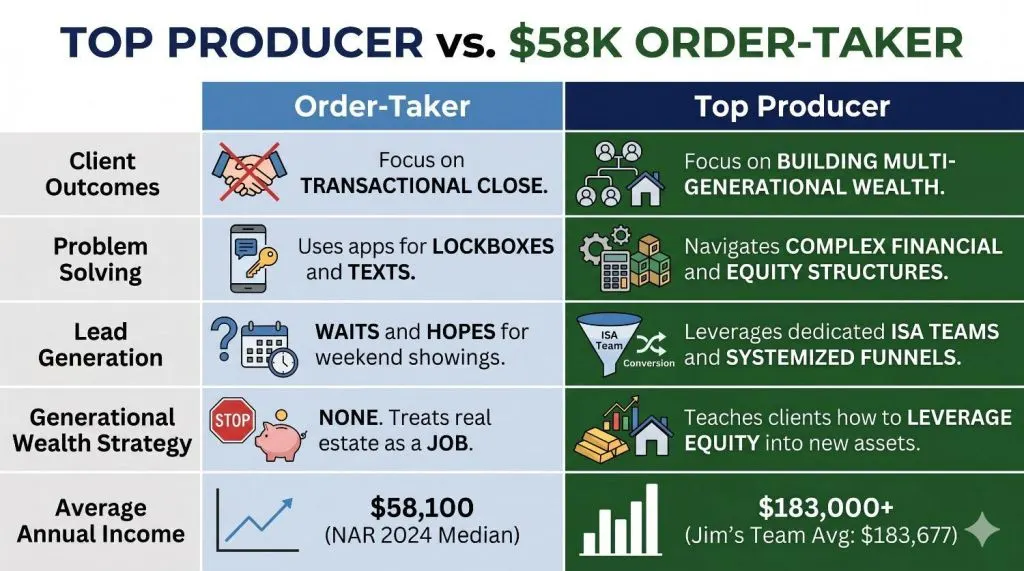
What landed for me was his point that 5% of agents do 95% of the business. The math is brutal, but it explains everything about why real estate agent income is so unevenly distributed across the industry.
Leads Are Cheap, Appointments Are What Actually Pay
The biggest operational difference between Jim’s team and almost every other shop I have seen is how he handles the top of his funnel. Most brokerages promise leads. Jim delivers appointments.
He told me a buyer appointment costs him $1,515, and a seller appointment costs $3,448. That is not a number you spend casually, and it is the reason he runs a dedicated team of inside sales agents made up of licensed Americans who work each lead until it converts. His record is 1,837 days.
“When our inside sales agents called them, they answered the phone. They had a 30 to 90-second conversation where they agreed to meet with an agent. They put it on their calendar. They responded to the calendar invite. Then they showed up at the driveway at the time. And you want to tell me that’s a bad lead?”
The lesson for any team leader listening is that a Facebook click is not a lead. A confirmed appointment with a real human who knows they are about to talk to a realtor is the only thing worth paying for.
The Buyer Agent Habits That Kill Deals
When I asked Jim about the number one mistake buyer agents make, he laughed and asked how much time I had. He listed several buyer agent mistakes I see constantly: setting up automated searches and letting clients do the hunting; communicating by text and email instead of picking up the phone; and leaving an appointment without ink on paper or a next face-to-face scheduled.
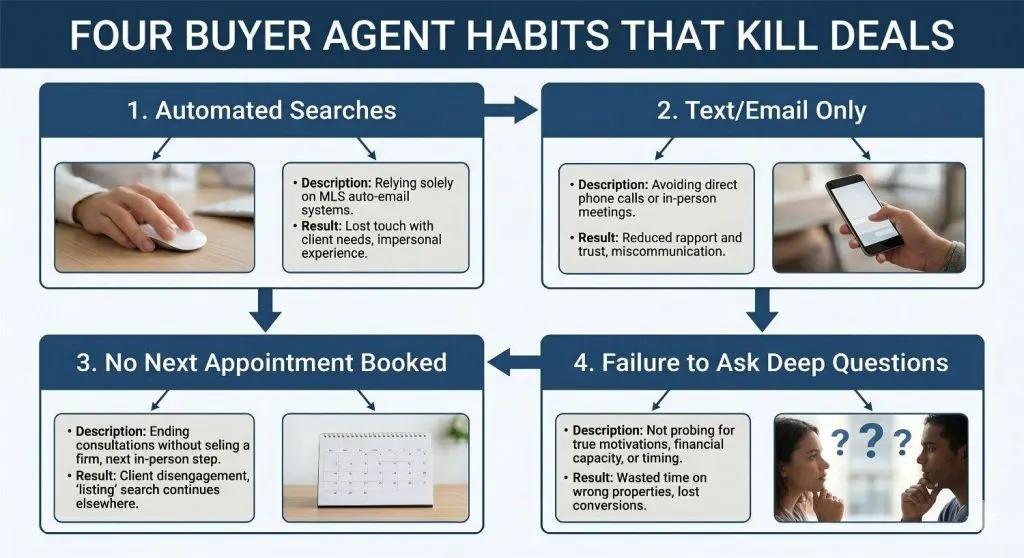
The greater skill Jim wants his agents to master is asking questions based on the client’s answers. He demoed it in front of his whole company by asking an agent her favorite color and ending up at skydiving in ninety seconds. That is the level of curiosity that turns a stranger into a buyer.
How a Cash Offer Platform Wins Retail Listings
Jim uses a cash offer platform that pulls twelve to seventeen investor offers for any address in under a minute. He runs the cash offer angle in his ads, on the radio, and on postcards. The phone rings. The ISA books the appointment. His agent shows up at the door with a stack of real offers in hand.
“All those other investors are gonna bring you exactly one offer. Theirs. That’s it. Theirs, under their terms. We’re gonna show up, and for the very first time I meet you at your front door, I’ll bring twelve to seventeen offers for your home. You pick the one that works best for you.”
Here is the twist. Most sellers do not actually take the cash offer once they understand the price gap. But the cash offers earn Jim’s agent the seat at the kitchen table, and a traditional conversation on selling a home begins from there. It is one of the smartest seller acquisition strategies I have seen.
What Changed for Me After This Conversation
“Rich means you have money. Wealth means you have time. It means that your passive investment income is exceeding what your cost of living is. Now you’ll never run out of money.”
That distinction changed how I think about coaching agents. Jim was wiped out in 2011 by a failed business venture, sat with $102,000 in credit card debt and $400 to his name in 2013, and rebuilt everything by tracking every dollar and treating taxes as an asset he could leverage.
My takeaway is that the agent income problem is really a financial literacy problem in disguise, and real estate team systems alone will not fix it if the agent has not learned to manage what they earn.
Want to hear my full conversation with Jim on why most agents are overpaid and how top producers earn six figures?
Frequently Asked Questions
How much does Jim Bottrell’s average team agent earn per year?
Jim shared that his average team agent took home $183,677 in 2025, well above the NAR national average of $58,000.
What is the difference between a lead and an appointment?
A lead is a contact who clicked an ad. An appointment is a confirmed meeting with a buyer or seller who knows they are about to speak with a realtor at a specific time and place.
Should new agents join a team right away?
Jim’s view is that the best team agents have one to two years of solo experience first. They understand how hard lead generation is, but they have not yet built bad habits that block coaching.
Apply as a Guest on the Real Estate Success DFW Podcast
The real estate industry is in the middle of a hard reset, and the agents who solve real problems are the ones who will thrive. If you are running a team, building a brand, or carrying lessons that newer agents need to hear, I want to talk to you. Jim Bottrell of The Jim Bottrell Real Estate Team set the bar high in this conversation, and I am building a community that helps agents succeed by featuring voices just like his!
Real Estate Success DFW is produced by Icons of Real Estate, the #1 Real Estate Podcast Network. If you are a real estate professional, apply to be a guest speaker across the network!
Never miss an episode
Subscribe to Real Estate Success DFW on your favorite app. Have a story or strategy other agents should hear? Apply to be a guest.
More episodes

Why Kevin Yoder of Infinite U and Yoder Real Estate Stopped Recruiting and Built a More Profitable Team
Why did Kevin Yoder of Infinite U and Yoder Real Estate stop recruiting? Learn how SOPs, AI, and sharper sales skills beat more leads and bigger teams.

The Brokerage Myth I Unpacked With Devin Dubuc of Mortgage Coaching on Loan Officer Success Live
A better split won't fix a slow pipeline. Get the review and follow-up systems shared on Loan Officer Success Live with Devin Dubuc Mortgage Coaching.

What Geoff Cavender of The Cavender Team Knows About Leads That Most Agents Miss
Paid leads rarely fail on their own. Geoff Cavender of The Cavender Team shares the follow-up system and delegation plan behind 450 deals. Learn how.