
How to Survive a Down Real Estate Market: Lessons from Brian Force
By Shaune Corbett·

According to NAR, existing home sales had decreased by 8.4% last January – going down from an annual pace of about 4.27 million homes the previous month to only 3.91 million. And if you’ve been wondering how to survive a down real estate market like this one, you’re in the right place.
In episode 59 of Real Estate Success DFW, I sat down with Brian Force, real estate entrepreneur and expert. What he shared wasn’t theory. It was a practical framework built on identity, fundamentals, and systems that hold regardless of market conditions.
Here’s what this article covers:
- Why your identity as an agent or entrepreneur determines your ceiling
- The 5 activities that actually generate income – and what to cut
- A simple sphere system that converts at 95%
►Watch the full conversation:
Agent Is a Role. Entrepreneur Is an Identity.
The Real Estate Entrepreneur Mindset That Changes Everything
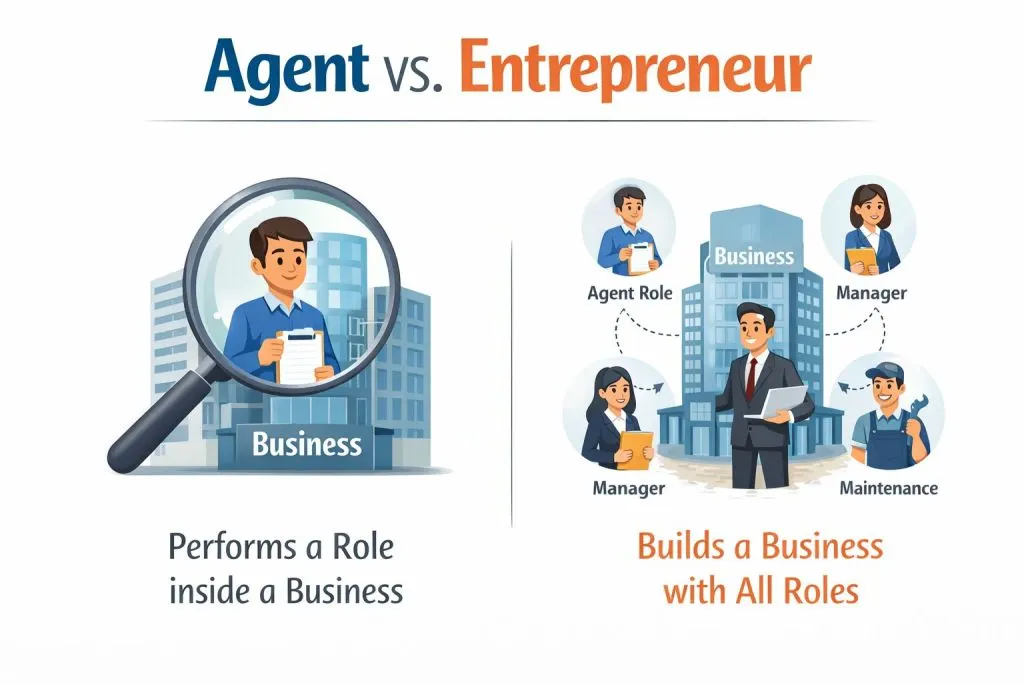
Brian’s first point in the podcast episode had nothing to do with tactics. It had to do with how you define yourself. A real estate entrepreneur mindset isn’t just a better way of thinking about the same job. It’s an entirely different frame.
An agent performs a role inside a business. An entrepreneur builds the business that contains all the roles – including the agent role.
Most agents stay stuck in the first definition. They limit their:
- Hiring decisions,
- Their systems,
- Their vision
This is all without realizing the ceiling is self-imposed.
Industry data shows that roughly 87% of new real estate agents leave the business within their first five years, often because they treat it like a job rather than building it like a business
As Brian said in the episode, the language we use shapes what we’re willing to build.
“The second that you get married to this idea of yourself as an agent and you stop thinking about yourself as an entrepreneur, you severely handicap your business.”
– Brian Force, Entrepreneur & Real Estate Expert </blockquote>
Building a Business
Brian eventually built a real estate business where he no longer served the agent role himself – other people handled that.
He was still working. He was just doing it at a different level of the business.
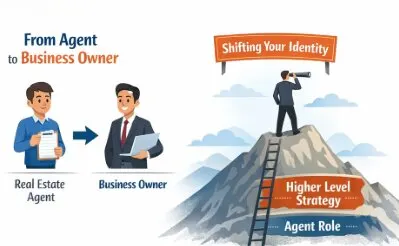
That only became possible when he stopped defining himself by the role and started building the structure around it.
His weekly Leading with Force newsletter covers this thinking every Tuesday for agents who want to operate the same way.
That identity shift is the foundation. Once it’s in place, surviving a down market becomes a much more concrete problem – one with a specific answer.
Stop Blaming the Market and Protect Your Market Share
Two Types of Agents Right Now
Every agent is working in the same market share real estate environment right now. The transactions available are the same for everyone.
The difference is entirely in who’s working and who’s waiting.
As Brian mentioned in the podcast episode, his mentor puts it simply: there has never been a market without enough market share to hit your goals.
Even in North Texas during its worst year, capturing just 1% of available market share would generate a billion dollars in GCI.
To put the scale in perspective, the average home value in the Dallas market is roughly $300,000 according to Zillow, meaning every thousand transactions represents roughly $300 million in sales volume
In other words, the opportunity pool is enormous. The question isn’t whether the market exists. It’s who is capturing it.
“I see agents that are getting back to the fundamentals succeeding at a very high level. And I see agents that are looking for shiny objects as a way out of a difficult market environment floundering and getting frustrated and acting like it’s the market’s fault. And that’s not the case.”– Brian Force, Entrepreneur & Real Estate Expert
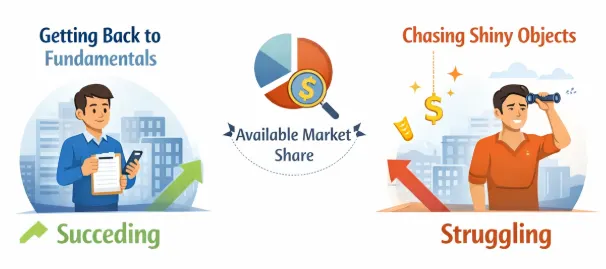
The agents succeeding right now aren’t doing anything exotic. They’re doing the repeatable work – and those habits compound hard when conditions improve. The more useful question is where exactly to focus that work.
How to Survive a Down Real Estate Market: Protect the 5 Dollar-Productive Activities
The Only Five Things That Make You Money
Brian’s framework on dollar productive activities real estate is the clearest filter I’ve heard for deciding how to spend a day. In the podcast episode, he named exactly five:
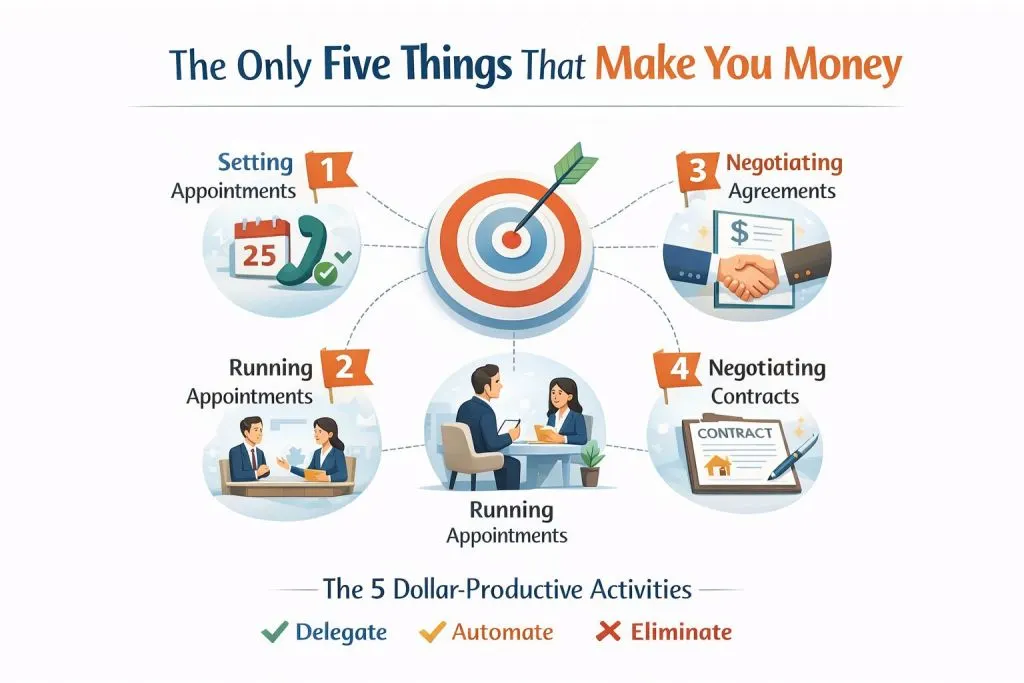
<table class=“has-fixed-layout”><tbody><tr><td><strong>The 5 Dollar-Productive Activities </strong>Setting appointments – lead generating and earning the right to represent a clientRunning appointments – sitting face-to-face and deciding if you’re the right fitNegotiating your agreements – not racing to the bottom on commissionNegotiating purchase and sale contracts – navigating the full transactionGoing to closings – the personal touch that keeps referral momentum moving</td></tr></tbody></table>
These 5-dollar productive activities are defined as the ONLY tasks that actually generate income for you, as a real estate agent.
Everything outside those five can and should be:
- Delegated
- Automated
- Or eliminated.
The goal is simple: more hours per day spent on the five, fewer on everything else. That’s the entire optimization problem.
AI in Real Estate Business: Empower the Agent, Don’t Erase Them
The Game You Can’t Win
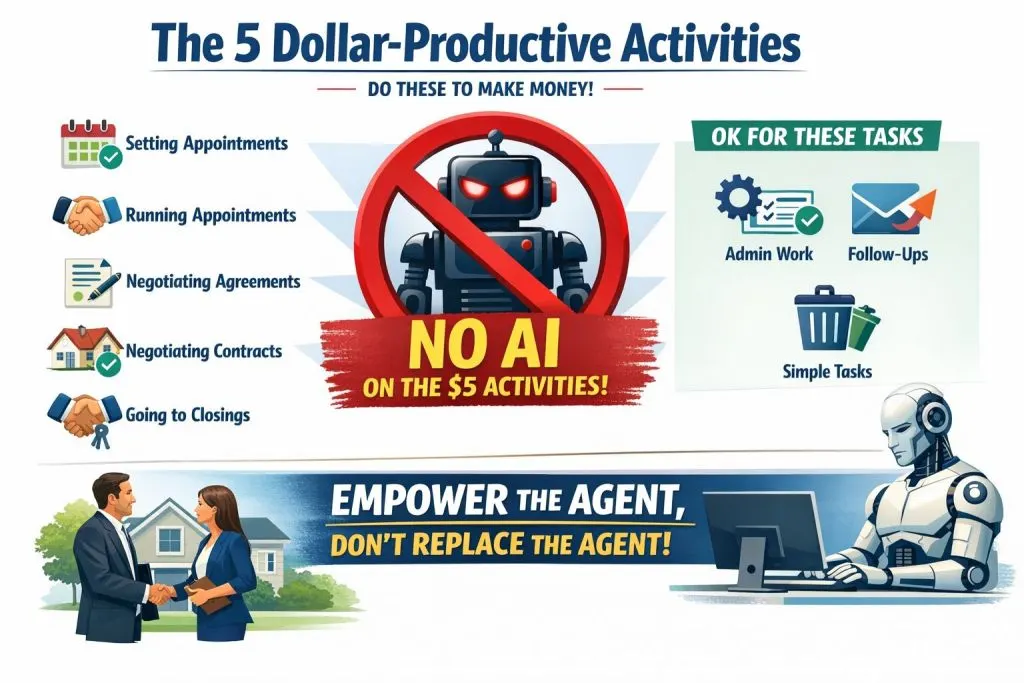
Using AI in real estate business workflows makes sense – for admin, follow-up, and anything that isn’t one of the five.
Where Brian draws a hard line is when agents try to automate the dollar-productive work itself, particularly lead generation.
His reasoning: the moment that becomes viable, every venture capital firm on the planet will outspend you on better AI agents. You won’t win that fight.
In fact, Goldman Sachs estimates the largest tech companies will spend over $200 billion annually on AI infrastructure by 2028. At that scale, AI-driven lead generation becomes a capital game that individual agents simply can’t compete with.
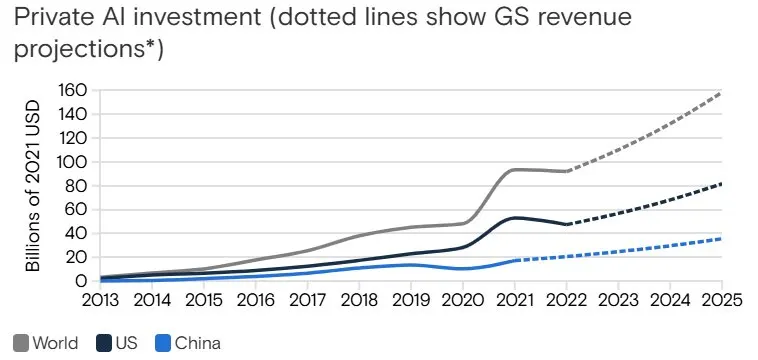
Source: Goldman Sachs
“I want to be the one doing the dollar-productive activities. I want to use technology to keep myself in the areas of the business that I know I am best suited for and that I know I bring unique value to.”
– Brian Force, Entrepreneur & Real Estate Expert </blockquote>
The right use of AI is to protect your time for the five activities – not to remove yourself from them. That protection starts with staying in front of the people who already trust you.
The Sphere of Influence Real Estate System

The sphere of influence real estate system Brian uses on the podcast episode is built on one principle: simplicity drives execution. He categorizes every contact into three groups using mnemonic devices:
- A – People who would bail you out of jail
- B – People it wouldn’t be weird to grab lunch with
- C – Everyone else who knows your name
The execution rule is one contact per person, minimum, every 90 days. Your A contacts get more. Nobody disappears for more than a quarter. And critically – the contact doesn’t have to be about real estate. A simple text, a coffee invite, checking in on their family. The relationship is the point.
“Being in contact with your database is the productive thing. The easier you make that, the more you’re going to actually execute.”
– Brian Force, Entrepreneur & Real Estate Expert </blockquote>
Conversion rates inside a well-maintained sphere consistently sit around 95%. No paid lead source comes close. The agents who protect this system while others wait for the market to turn are the ones who will be positioned for the rebound.
Unique Selling Proposition Real Estate: Stop Being a Commodity
A strong unique selling proposition real estate agents can use doesn’t need to be elaborate.
On Real Estate Success DFW, Brian described three agents at the same listing appointment:
<table class=“has-fixed-layout”><tbody><tr><td><strong>Agent</strong></td><td><strong>Approach</strong></td><td><strong>Seller Reaction</strong></td></tr><tr><td>Agent #1</td><td>Cuts commission to win the listing</td><td>Looks like a commodity</td></tr><tr><td>Agent #2</td><td>Agrees with whatever price the seller wants</td><td>Adds no strategic value</td></tr><tr><td>Agent #3</td><td>Shows up with guarantees and a clear selling strategy</td><td>Wins the listing</td></tr></tbody></table>
The third agent wins every time – not because of luck, but because they’ve made a specific, credible offer.
Guaranteed cash offers, buy-back programs, off-market access – these are all accessible to any agent willing to set them up. They generate inbound interest instead of cold outreach, and inbound converts at dramatically higher rates.
Pair a sharp USP with a live sphere system and you’re not waiting for the market to improve. You’re building pipeline right now.
Real estate market volatility hasn’t created a shortage of opportunity – it’s redistributed it.
Final Words
The agents who win the rebound are the ones building momentum before the market turns.
In the podcast, Brian emphasized three priorities during a slowdown:
-
Stay in contact with your database
-
Provide consistent value
-
Define a clear unique selling proposition
Waiting for the market to improve before taking action is a mistake. When activity returns, agents who delayed will be trying to build momentum while others already have it.
Learning how to survive a down real estate market means doing the work now. The agents who maintain relationships, stay visible in their sphere, and sharpen their offer today will already have a running start when transaction volume rebounds.
Frequently Asked Questions
How do you survive a down real estate market?
Focus on fundamentals: your five dollar-productive activities, consistent sphere of influence contact every 90 days, and a clear unique selling proposition. Market share is always available for agents who show up. As Brian Force noted in the podcast episode, transaction volume per agent normalizes as competition exits – which means the agents still working are capturing more.
What is the difference between a real estate agent and a real estate entrepreneur?
An agent performs a role inside a business. An entrepreneur builds and scales the business that contains that role. As Brian explained on Real Estate Success DFW, defining yourself only as an agent keeps you in a box – limits your hiring decisions, your systems thinking, and your ultimate scale.
Should agents use AI to automate lead generation?
No. Lead generation is one of the five dollar-productive activities that Brian’s framework explicitly protects. Use AI in real estate business to eliminate admin, automate follow-up, and handle non-dollar-productive tasks. Automating the high-value human work puts you in direct competition with venture capital firms that will always outspend you.
What is the Leading with Force newsletter?
Leading with Force is Brian Force’s weekly podcast, published every Tuesday. It covers business, markets, and entrepreneurship insights condensed into one practical read for real estate professionals.
This podcast is produced by the Icons of Real Estate – #1 Real Estate Podcast Network
Never miss an episode
Subscribe to Real Estate Success DFW on your favorite app. Have a story or strategy other agents should hear? Apply to be a guest.
More episodes
Why Kevin Yoder of Infinite U and Yoder Real Estate Stopped Recruiting and Built a More Profitable Team
Why did Kevin Yoder of Infinite U and Yoder Real Estate stop recruiting? Learn how SOPs, AI, and sharper sales skills beat more leads and bigger teams.

The Brokerage Myth I Unpacked With Devin Dubuc of Mortgage Coaching on Loan Officer Success Live
A better split won't fix a slow pipeline. Get the review and follow-up systems shared on Loan Officer Success Live with Devin Dubuc Mortgage Coaching.

What Geoff Cavender of The Cavender Team Knows About Leads That Most Agents Miss
Paid leads rarely fail on their own. Geoff Cavender of The Cavender Team shares the follow-up system and delegation plan behind 450 deals. Learn how.