
Dana Pollard on Selling Luxury Real Estate from a "Trailer House" Background
By Shaune Corbett· · Updated

Most agents assume the luxury market is reserved for people who grew up in it—people with the right connections, the right zip code, and the right background. That assumption costs them a fortune.
I recently had the pleasure of sitting down with Dana Pollard of Dana Pollard Group on Real Estate Success DFW to unpack how she went from growing up in a trailer house in Azle, Texas, to closing multi-million dollar deals in Dallas-Fort Worth. What Dana shared challenged almost every assumption I had about selling to high-net-worth clients, building a YouTube channel that actually converts, and keeping a marriage intact while running a real estate business. Her insights are for agents—who are stuck at a lower price point—to understand how to level up, not by pretending to be someone else, but by becoming a genuine expert.
Here’s a preview of this episode
Why I Had This Conversation
I’ve always been curious about agents who sell at price points well above the norm, not because they inherited a Rolodex, but because they earned it. My average sale sits around $375,000 to $400,000, and Dana’s average is roughly double that. We’re only 15 miles apart in DFW, but we operate in very different worlds.
Dana was the top team in one of the most competitive Keller Williams offices in our market, one that specifically addresses luxury. She scaled to 200 units a year and built a YouTube channel with nearly 20,000 subscribers.
That credibility is what earned her a seat on this podcast and what makes her insights worth paying attention to if you want to stop competing for the same mid-range listings as 1.5 million other agents.
The Mindset Barrier That Keeps Agents Out of Luxury
Dana’s first piece of advice surprised me: before you change your marketing, change your language.
She calls this dropping “Walmart language”, phrases like “if you’re lucky enough to get into this neighborhood” or “I could never afford that.” These reveal a scarcity mindset that luxury buyers pick up on immediately.
A luxury real estate mindset isn’t about faking wealth. It’s about removing judgment from how you talk about money, in either direction.
The biggest barrier is our mentality about who those people are, when really we’re all just people. If you’re an expert, correct your language to think non-judgmental for any price point, and I think it’s golden.
To make this concrete, here’s what that language shift actually looks like in practice.
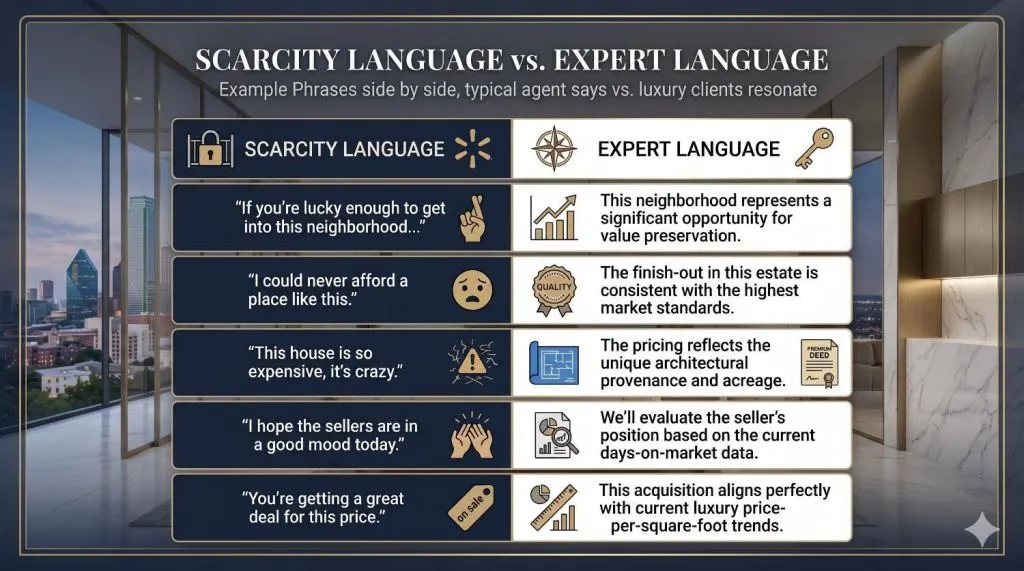
The pattern is clear. High-net-worth clients aren’t screening your background; they’re screening your competence. They care that you’re an expert in their market, not where you grew up. The fear that you don’t belong is internal. Dana proved that by going from zero sales in her first year to breaking into the luxury market with deals above $2 million.
Why YouTube Beat Door Knocking for Luxury Leads
In 2019, Dana was knocking on doors and struggling to generate leads without cold calling. She went all in on YouTube, and the results were transformational! Her channel, Texas Luxury, now drives buyer leads at a close rate of 1 out of every 5 inquiries. That kind of YouTube lead generation for realtors is nearly unheard of compared to paid ad conversion rates.
What makes YouTube powerful isn’t just reach, but positioning. When a buyer reaches out after watching your videos, they already see you as a celebrity. Dana told me her luxury sellers love the channel, too, because most competing listing agents are old-school networkers with no digital presence. Her community credibility was built on camera, not at cocktail parties.
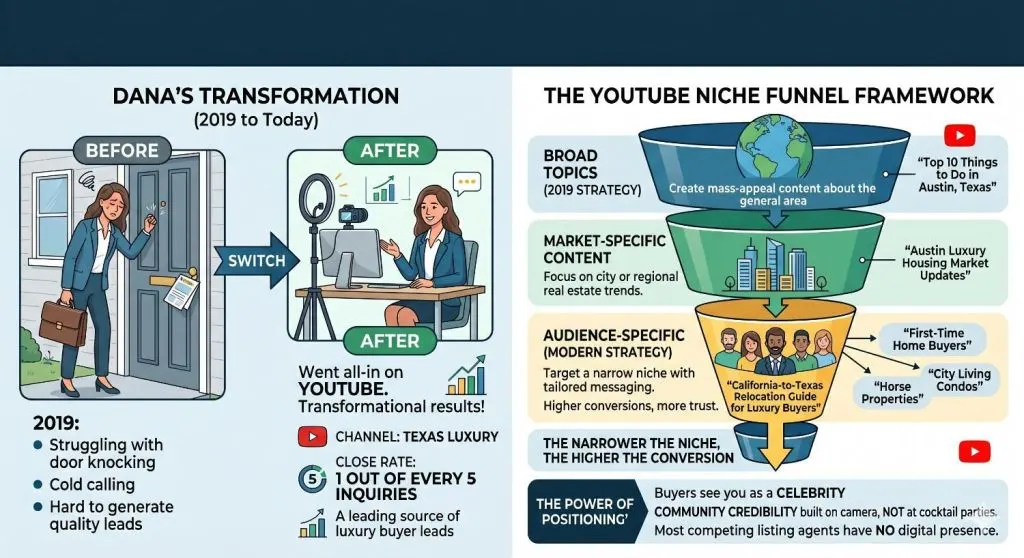
This funnel is exactly how Dana approaches content strategy today. General content worked in 2019, but now you need to target a specific audience and certain criteria, like first-time buyers, California-to-Texas relocations, horse properties, and city living. The narrower the niche, the higher the conversion.
The Content Edge AI Cannot Replicate
Dana uses AI tools heavily, but she shared a strategy that stopped me in my tracks. For her Westlake listings, she manually pulls MLS records and county tax appraisals to show buyers exactly how assessed values shifted year over year after purchase. That’s the kind of hyper-local data ChatGPT cannot generate, and it’s the difference between a video that informs and one that converts.
“My goal is when I produce a video or any content, I want to produce some nuggets that AI cannot provide. That kind of content is going to be highly valuable when it comes to video or social media, or even just your clients.”
If you’re creating content for a luxury audience, generic neighborhood overviews won’t cut it. Buyers at the $4 million level want to know whether the county will jack their tax appraisal up to match their purchase price—and by how much.
That level of specificity is what separates experts from aggregators, and it’s why Dana’s content converts while most agents’ videos collect dust. Anyone involved in selling luxury homes understands that expertise at this level is non-negotiable.
Debunking the “High Maintenance” Myth About Luxury Clients
I’ll admit, I had assumptions about luxury buyers being demanding. Dana debunked that completely.
She told me about a $10 million buyer who was the most low-maintenance client she’s ever worked with. People are people regardless of budget. You’ll find high-maintenance clients at $400,000 and low-maintenance clients at $6 million. The only real difference at higher price points is the level of expertise expected, and that’s your job anyway.
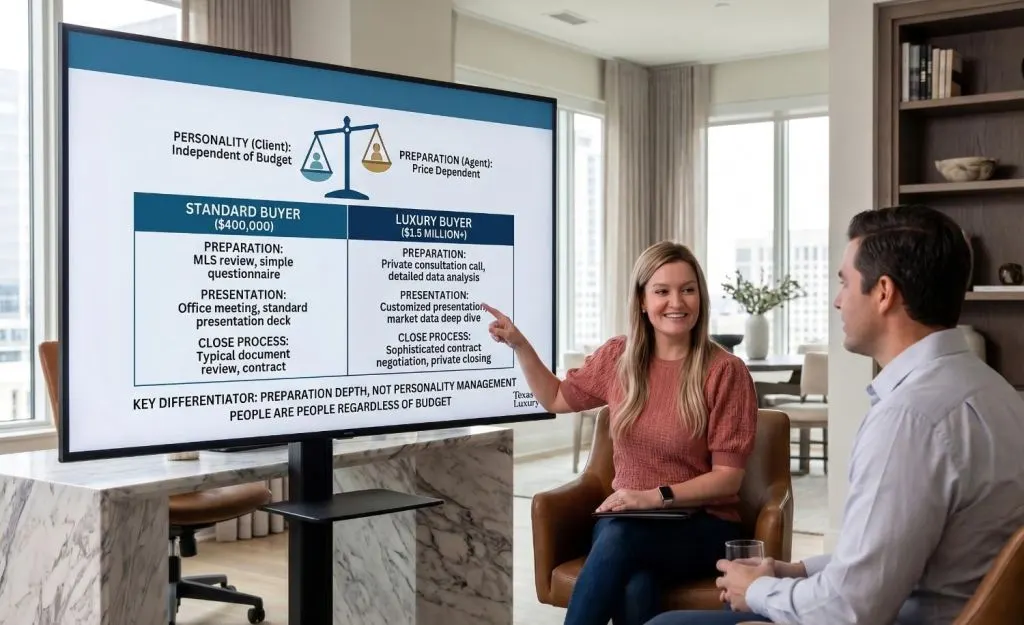
That difference in preparation is where Dana draws the line. She customizes her buyer consultations for clients above $1.5 million, preparing tailored presentations with market data and private consultation calls. Below that threshold, a standard buyer consultation works fine.
The distinction is preparation depth, not personality management. If you want to understand what your own property positioning looks like before stepping into this arena, a home evaluation is a practical starting point.
The Glass Ball Theory for Real Estate Marriage Balance
Dana and her husband work full-time together in the business, and she admitted they almost didn’t survive the first year. The breakthrough came when they stopped tracking each other’s hours and started respecting each other’s strengths. He handles showings, open houses, inspections, and networking. She runs strategy, content, and lead generation.
Maintaining real estate marriage balance requires treating your relationship like a glass ball; everything else in business is rubber and will bounce back if dropped. The marriage won’t.
“You can mess everything up in business and you can always come back, but if you mess up your marriage — once it breaks, it breaks.”
They schedule weekly date nights like client appointments, with phones off and full attention. They set clear boundaries with clients: no work after 6 PM unless actively negotiating a deal.
And, when a last-minute showing request comes in, Dana doesn’t become a “pop-tart.” She hires a showing agent to leverage a move for $50 to $200 and buys back three hours of family time. That’s the highest-ROI decision most agents refuse to make.
What Changed for Me After This Conversation
Talking to Dana forced me to confront my own assumptions about the luxury market. I realized the barriers I see are mostly internal: scarcity thinking, assumptions about client expectations, and the belief that luxury requires a pedigree. Dana is living proof that expertise, consistent content, and the discipline to protect your personal life matter far more than where you started, which is something that I want to share with my agent community.
I now think differently about showing agent leverage as a tool, not an expense. And, I see YouTube not just as a lead source but as a credibility asset that strengthens every other part of your business, from listing presentations to client trust.
Want to hear my full conversation with Dana Pollard of Dana Pollard Group on breaking into luxury real estate and achieving success?
Frequently Asked Questions
How do I break into the luxury real estate market without connections?
Focus on becoming a market expert first. Study tax records, pricing trends, and neighborhood-level data at the higher price points. Luxury clients care more about your competence than your background or network.
Does YouTube actually generate real estate leads?
Yes. Dana closes 1 out of every 5 YouTube leads, which is a conversion rate that far exceeds most paid advertising channels. The key is niching your content to a specific audience and market.
How do I keep my marriage healthy while working in real estate?
Set firm boundaries on work hours, schedule regular date nights like client appointments, and hire showing agents to protect family time. Identify each partner’s strengths and stop tracking hours.
Apply as a Guest on the Real Estate Success DFW Podcast
The market is shifting, and the agents who adapt are the ones who’ll thrive. If you’re actively working in real estate and solving real problems, whether in luxury sales, digital marketing, team building, or market strategy, I want to hear your story!
Real Estate Success DFW is produced by Icons of Real Estate, the #1 Real Estate Podcast Network. If you are a real estate professional, apply to be a guest speaker across the network!
Never miss an episode
Subscribe to Real Estate Success DFW on your favorite app. Have a story or strategy other agents should hear? Apply to be a guest.
More episodes
Why Kevin Yoder of Infinite U and Yoder Real Estate Stopped Recruiting and Built a More Profitable Team
Why did Kevin Yoder of Infinite U and Yoder Real Estate stop recruiting? Learn how SOPs, AI, and sharper sales skills beat more leads and bigger teams.

The Brokerage Myth I Unpacked With Devin Dubuc of Mortgage Coaching on Loan Officer Success Live
A better split won't fix a slow pipeline. Get the review and follow-up systems shared on Loan Officer Success Live with Devin Dubuc Mortgage Coaching.

What Geoff Cavender of The Cavender Team Knows About Leads That Most Agents Miss
Paid leads rarely fail on their own. Geoff Cavender of The Cavender Team shares the follow-up system and delegation plan behind 450 deals. Learn how.