
Bart Gurley, Real Estate Coach: Why Most Agents Stall (And How Habits, Process, and Positioning Fix It)
By Shaune Corbett· · Updated
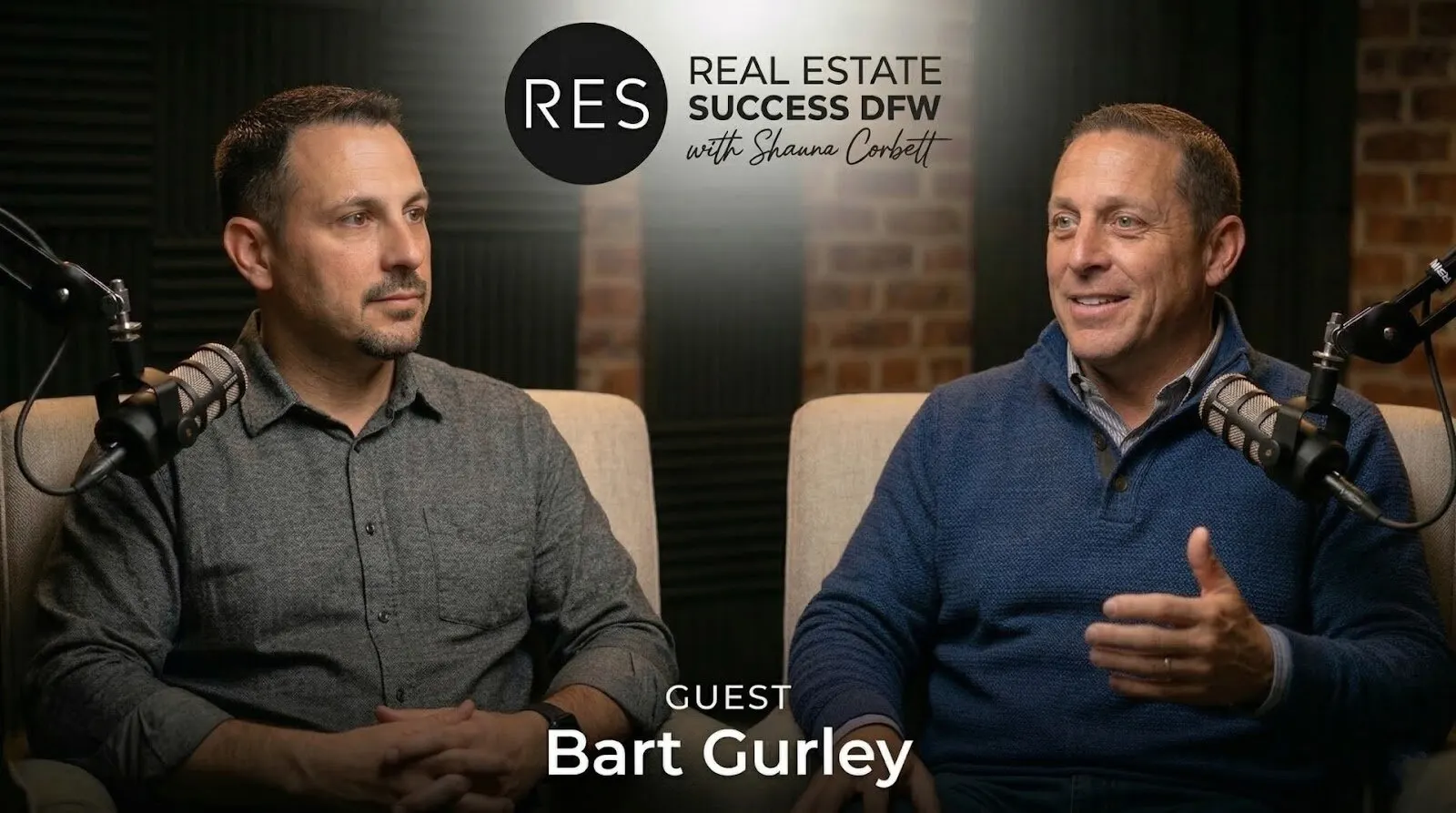
About ten minutes into my conversation with Bart Gurley, real estate coach and industry veteran, on Real Estate Success DFW, he said four words that cut through every “grind harder” post I’ve ever scrolled past: “Hustle is not going to scale.”
Bart and I have crossed paths at events for a couple of years, but it took one long sit-down last summer to realize we’re wired the same way, both trying to get agents off the hamster wheel. He’s been licensed since the late ’90s and runs both a brokerage and an in-house lending operation, and that experience is what gives the line its weight.
What came out of our conversation is a blueprint—four daily habits, a financial consultation framework called the Smart Move Financial Analysis, and a positioning strategy that produces $5 million in referrals a year on almost no marketing spend. If your pipeline keeps stalling, the problem probably isn’t the market; it’s the need for a system that finally replaces the grind.
If you’re ready to see how these veteran insights play out in real-time, catch Bart’s latest on LinkedIn, Instagram, and Facebook.
Watch the full episode here:
%%YT:h_9tOSKPF3U%%
Who Is Bart Gurley?

Bart walked into real estate at 23 with a Bachelor of Arts in History and no business training. His first year, he earned just under $40,000 in GCI when the average sale price sat between $135,000 and $170,000. That was enough for Rookie of the Year consideration at most brokerages in the late ’90s. He got his license because, as he put it, he didn’t know what else to do.
What kept him in the industry was the advisory role. “I liked being an authority to serve somebody else,” he told me. That instinct eventually led to a dual-licensed career spanning residential sales, mortgage lending, and agent coaching. Maverick Realty Network helps agents build scalable businesses through advisory leadership and documented processes that compound over time.
The Real Reason Agents Stall (It’s Not the Market)
I hear agents blame rates and inventory every week. Bart has been through worse markets and doesn’t accept the excuse. His reasoning is worth hearing in full:
“It’s not the market conditions. Everyone can see the market hasn’t changed. When I started, we had 8% interest rates and we closed plenty of business. The rate and market conditions are not the problem. The problem is the advisory position. They are paying for you to read their fears, educate them, and proceed only once they give you the nod. It’s a methodical process. I only improved my close rate when I started writing it down. I don’t have deals that don’t close, barring a job loss or a health crisis.”
That tracks with my own experience across 500-plus closings. Agents who stall almost always trace it back to weak advisory foundations. The data confirms what Bart sees in his coaching — more than 1.5 million agents compete for roughly 5 million annual sales, and the ones who survive have a documented process from early on.
Habits Scale — Hustle Does Not
When I asked Bart about daily practices, his answer went straight to friction removal.
“Habits are where the rubber meets the road. Hustle does not scale. Hustle is not going to scale, but habits do because they remove friction between you and your partners, clients, and the opposition. Habits create a smooth process for prospecting, execution, or follow-up.”
When your day runs on habits, you stop spending mental energy on decisions that should already be made. That’s how real estate habits that scale actually work in practice: they free up bandwidth for the advisory work that generates revenue.
The Four Daily Habits That Build a Referral Machine
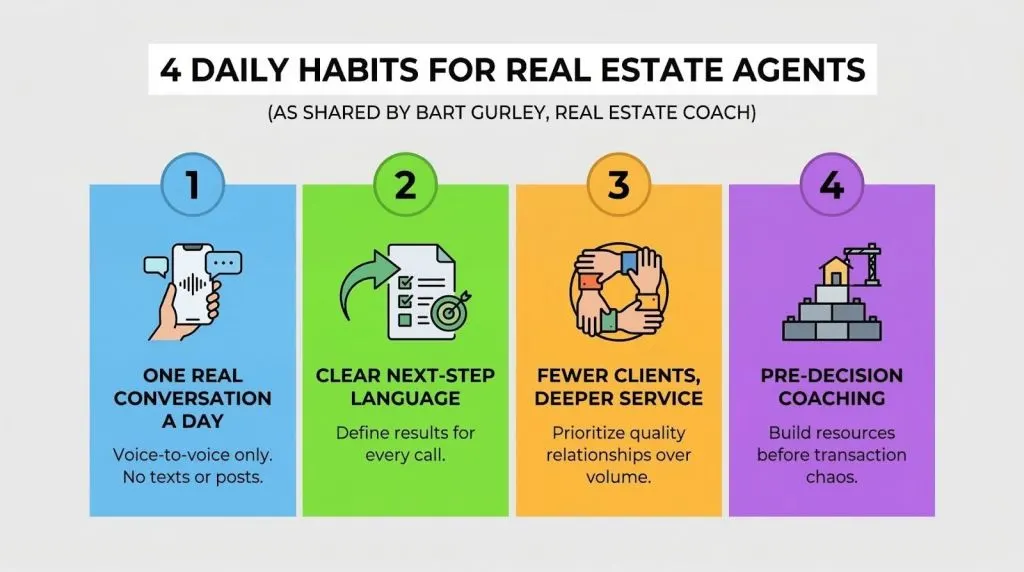
I got four specific habits from our conversation. I wrote them down because they’re the kind of thing that sounds simple until you realize you aren’t doing any of them consistently.
<table class=“has-fixed-layout”><tbody><tr><td><strong>Habit</strong></td><td><strong>What It Looks Like</strong></td><td><strong>What It Solves</strong></td></tr><tr><td><strong>One real conversation a day</strong></td><td>Voice-to-voice, no texts or posts</td><td>Inconsistent pipeline</td></tr><tr><td><strong>Clear next-step language</strong></td><td>Every call ends with a defined result</td><td>Accountability gaps</td></tr><tr><td><strong>Fewer clients, deeper service</strong></td><td>Quality relationships over volume</td><td>Burnout and churn</td></tr><tr><td><strong>Pre-decision coaching</strong></td><td>Build resources before the chaos</td><td>Reactive scrambling</td></tr></tbody></table>
The fourth habit stuck with me most. Real estate systems and processes matter, but habits are what make them stick. Bart builds the framework ahead of time so that by the point decisions arrive, the structure already exists. He told me you need resources built out before you’re in the middle of a live transaction, or you’ll get stuck creating them under pressure. The Real Estate Success DFW community is built around that kind of daily accountability if you’re looking for agents who operate the same way.
If You Act Like an Assistant, Clients Act Like a Boss
This was one of the most direct moments in our conversation. Bart didn’t soften it:
“If you act like an assistant, the client will act like a boss. That’s as simple as I can make it. You’re creating the way you’re spoken to and your value by not having a process. Your core brand is built around a process. When you don’t have a process, you don’t have a brand.”
I’ve seen this firsthand. I’ve worked with aggressive Type A clients who stopped pushing the moment I walked them through my steps. The fastest way to build authority as a real estate agent is structure. When clients understand how you operate, they stop calling every day because they know you’re in alignment with their definition of success.
Why Transactions Really Fall Apart
Bart’s approach to preventing deal collapse starts at the first meeting, not at the option period. Here’s how he describes it:
“I go through a Smart Move Financial Analysis for every client from day one. I am trying to find the nos, the friction, and the sensitivity. We handle the money upfront. We look at the net sheet on their existing home and the quote on the new mortgage. We go through everything, 401k money, retirement planning, all in that first meeting. I’m establishing an accountability baseline. When we get to the option period, I already have a yes, and we’re just trying to stay within the brackets we discussed.”
By the time a contract hits the table, the financial conversation has already happened. That’s why Bart’s close rate stays consistent regardless of where rates or inventory sit.
Eliminate Analysis Paralysis Through Decision Framing
Bart calls himself a “decision adviser,” and that framing matters. After the initial consultation, he outlines a plan and strips away anything that doesn’t serve the client’s stated goal. “Anything that isn’t part of delivering their goal doesn’t even get mentioned,” he told me. “They only get the decisions required to obtain the goal. That keeps things clean and simple.”
I made the same mistake early in my career: over-educating clients on things that didn’t apply and watching them freeze. As a real estate coach, Bart Gurley saw that pattern across hundreds of agents. The fix was narrowing the conversation to what actually matters and letting the rest go.
Positioning Always Beats Pricing
Bart told me flat out: “Positioning for a seller always beats pricing.” Homes sell when they’re clearly positioned against what’s currently available, and chasing price reductions in the middle of a listing never works.
I tell my sellers the same thing. Comps give us a guide, but what matters to a buyer right now is what’s sitting on the market today. If we don’t beat the active competition, we’re in a race to the bottom. Bart added something worth holding onto: “We aren’t paid to list houses; we’re paid to sell them. You’re being paid for your advice, so give it.”
Agents who over-list out of fear of losing the opportunity watch everyone lose, the agent and the client alike. I’ve written more about how I approach listing conversations on the Real Estate Success DFW blog.
Foundational Skills No Brokerage Teaches
Bart made a point that keeps coming up in my conversations with high-producing agents: foundational business skills don’t get taught in most real estate training programs.
“Foundational elements are not being taught in our industry. I didn’t learn them at my brokerages or when I got my license. Think about Michael Jordan and the free throws he shot that nobody saw.”
His Chick-fil-A comparison landed well. Why is every sandwich the same? Because there’s a documented process behind it. “Most agents have no product and no rules,” Bart said. The gap between a plateaued agent and a growing one often comes down to documentation. If you’re interested in building a show around your own expertise, the Icons of Real Estate podcast production page walks through what that process looks like.
Referral-Based Business Without Marketing Spend
Bart spends “next to zero dollars on pure marketing” and still generates $5 million in annual referrals. That’s the math when you go deep with every client.
His model runs on relationships and process. Bart Gurley’s real estate coaching philosophy centers on this: go deeper with the people already in your sphere, and the referrals come on their own. He gave me a direct warning: “If you have operational inefficiencies and you try to scale, it will impact your profits by 30 to 40%.” The data paints a similar picture — process breakdowns remain one of the top reasons firms hit a ceiling.
The Lifetime Value Mindset
Bart values every client at $120,000 to $130,000 over their lifetime. That number reframes who deserves your energy. When each relationship carries six-figure potential, personality alignment matters as much as the immediate transaction.
As a real estate coach, Bart Gurley challenged every agent listening: go look at every house you’ve ever sold and proactively run a tax protest for those homeowners for free using AI. That single gesture builds the kind of value that turns a base of 100 past clients into a self-sustaining referral engine.
When those clients know, like, and trust you, everyone in the world becomes a prospect. You can learn more about my approach to real estate in DFW and what drives this show.
What Maverick Realty Network Offers
Bart runs an eight-week program that includes small group sessions and one-on-one elements. What stood out to me is the intake process: he interviews every applicant with a 15 to 45-minute call to hear about their production and target audience. No selling happens on that call. He goes away, builds a plan, and only moves forward if alignment exists.
The coaching covers:
- Foundational habit development
- Structured consultation training
- Financial advisory scripting
- Process building and SOP creation
If you’re looking to explore other real estate shows, the Icons of Real Estate Podcast Network features dozens of programs covering markets across the country.
Frequently Asked Questions
Who is Bart Gurley?
Bart is a real estate veteran licensed since the late 1990s and a licensed mortgage lender. He specializes in helping agents build scalable, referral-driven businesses through daily habits and structured consultations.
What is Maverick Realty Network?
It’s an eight-week small group development program focused on foundational habits, consultation frameworks, and process creation for real estate agents. The program includes one-on-one elements and a thorough intake interview before enrollment.
Why do real estate transactions stall?
Bart says transactions stall when agents skip structured advisory work during the initial consultation. Addressing financial sensitivities and potential objections upfront prevents deals from collapsing during the option period.
What daily habits should Realtors follow?
Bart recommends four: one real conversation per day, clear next-step language in every interaction, fewer clients with deeper service, and pre-decision coaching before problems arise.
How do you eliminate analysis paralysis in buyers?
By narrowing the conversation to only the decisions required to reach the client’s goal. Bart removes irrelevant information during the consultation and focuses exclusively on what moves the transaction forward.
What is the Smart Move Financial Analysis?
It’s Bart’s first-meeting framework where he reviews net sheets, mortgage estimates, retirement considerations, and financial sensitivities to establish written accountability before any showings begin.
Why is positioning more important than pricing?
Homes sell because they’re positioned against active competition. Pricing off old comps misses what buyers actually see on the market today. Chasing reductions mid-listing signals weakness and rarely produces results.
How can Realtors build a referral-based business without ads?
By going deeper with existing clients and maintaining consistent daily habits. Bart generates $5 million in annual referrals with near-zero marketing spend by focusing on process and long-term relationships.
How do you create systems as a solo real estate agent?
Start by documenting what you already do. Bart emphasizes that if your steps aren’t written down, they aren’t a process. Standard Operating Procedures for consultations, follow-ups, and closings create the consistency that builds a brand.
What foundational skills are missing in most real estate training?
Bart says brokerages don’t teach consultation structure, financial advisory methods, client filtering, or process documentation. These skills determine whether an agent plateaus or scales, and most are left to figure them out alone.
This podcast is produced by the Icons of Real Estate – #1 Real Estate Podcast Network
Never miss an episode
Subscribe to Real Estate Success DFW on your favorite app. Have a story or strategy other agents should hear? Apply to be a guest.
More episodes
Why Kevin Yoder of Infinite U and Yoder Real Estate Stopped Recruiting and Built a More Profitable Team
Why did Kevin Yoder of Infinite U and Yoder Real Estate stop recruiting? Learn how SOPs, AI, and sharper sales skills beat more leads and bigger teams.

The Brokerage Myth I Unpacked With Devin Dubuc of Mortgage Coaching on Loan Officer Success Live
A better split won't fix a slow pipeline. Get the review and follow-up systems shared on Loan Officer Success Live with Devin Dubuc Mortgage Coaching.

What Geoff Cavender of The Cavender Team Knows About Leads That Most Agents Miss
Paid leads rarely fail on their own. Geoff Cavender of The Cavender Team shares the follow-up system and delegation plan behind 450 deals. Learn how.