
How Barbara Schlinker of Barb Has the Buyers Built a 3,000-Transaction Career Through Direct Response Marketing
By Shaune Corbett· · Updated

Every year, thousands of newly licensed agents walk into a brokerage, hang their license on the wall, and immediately hear the same tired advice: pick up the phone book and start cold calling. No system, no training, no checklist—just dial and pray. It’s the single biggest reason agents burn out before they ever build anything sustainable.
I had the pleasure of sitting down with Barbara Schlinker of Barb Has the Buyers to talk about what happens when you reject that model entirely. Barbara shared how she applied aviation-grade discipline and direct response marketing to build a career of over 3,000 closed transactions, with 90% of her clients being perfect strangers who found her through her systems, not the other way around.
Watch the full episode here:
Why I Had This Conversation
When I came across Barbara, I knew this was a conversation worth having because her entire model is built on the opposite principle. She does not chase. Clients chase her.
Barbara is a former air traffic controller, Navy intel officer, and commercial airline pilot who brought that same checklist-driven, systems-first discipline into real estate. She has closed roughly 3,000 homes over a career spanning 30 years in Colorado Springs.
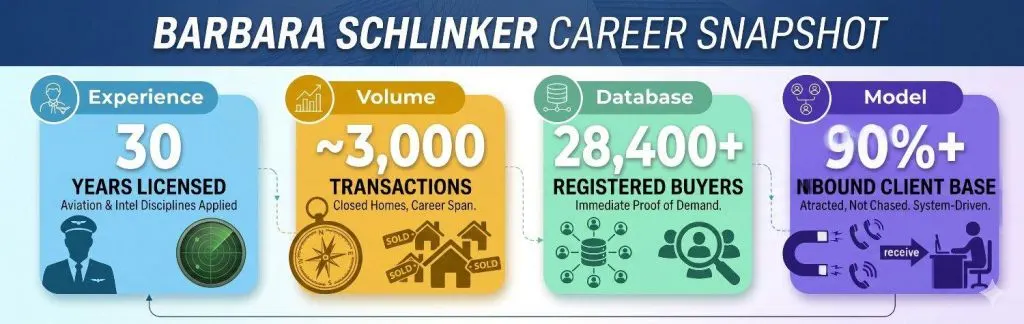
What makes her different is not just volume; it is how she generates that volume. At least 90% of her clients are people she has never met before. They find her through her marketing, her radio show, and her brand. That is rare in this business, and it is exactly the kind of model I want agents in my community for real estate success to learn from.
Why Direct Response Marketing Changes Everything for Agents
When Barbara started in the late 90s, her broker’s best advice was to pick up the phone book and cold call. That was the industry standard. And honestly, in a lot of offices, it still is. Brokers still tell agents to knock on the doors of strangers. Barbara’s response to that was simple: she doesn’t answer the door or the phone for people she does not know, and neither does anyone else.So she invested in learning direct response marketing, a framework popularized by Dan Kennedy. The core structure is straightforward: present a problem, agitate the problem, offer a solution, and include a clear call to action.
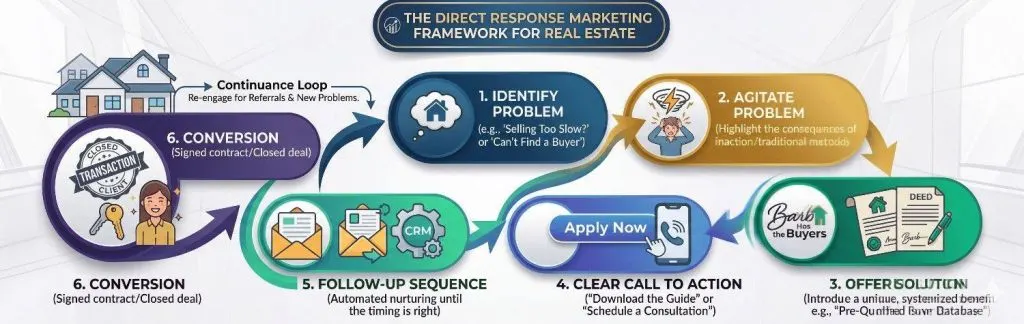
Every piece of marketing Barbara puts out follows this format. Her radio show, her website, her ads—they all lead consumers to contact her, not the other way around. And here is the part most agents miss: those leads are not always ready to buy or sell immediately. Barbara discovered that on her website, people were registering, but there was no follow-up sequence after that. Once she built in proper follow-up, her conversion improved significantly.
The lesson is clear: direct response marketing in real estate is not just about getting the lead. It is about nurturing it until the timing is right.
The “Barb Has the Buyers” Brand and Why It Works
The origin story of Barbara’s brand is brilliantly simple. She was at a coaching conference, walked past a colleague from Phoenix who mentioned advertising “Carol Has the Buyers” on the radio. Barbara immediately pulled out her iPad and bought “barbhasthebuyers.com” on the spot. That single decision became the foundation of her entire public identity.
When you advertise on radio, people cannot easily remember phone numbers. But a phrase like “Barb Has the Buyers” sticks. As Barbara put it:
“They can’t remember Schlinker. That’s a hard name to remember. But they remember Barb Has the Buyers. So it’s been a really good investment for me.”
And it’s not just a tagline. She built a registered buyer database of over 28,400 leads. When she walks into a listing appointment, she can pull up the system, enter the home’s criteria, and show the seller a printout of buyers who match their property. That is a real estate value proposition most agents cannot even come close to offering.
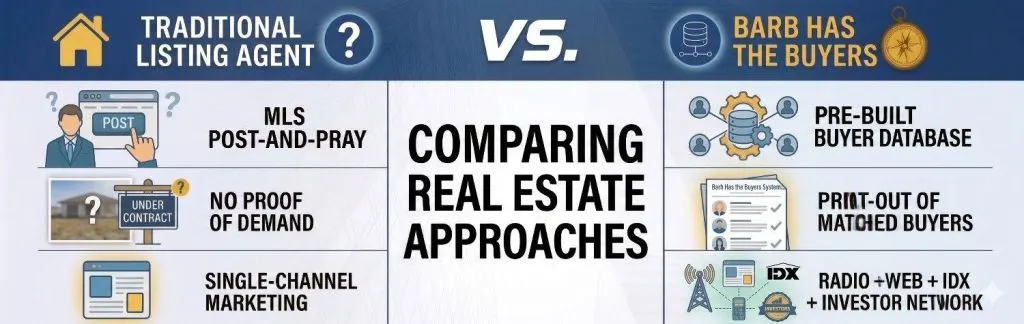
On top of the registered buyer database, she also maintains relationships with cash buyers and investors, giving her the ability to present roughly a dozen cash offers on a home before it even hits the market.
How Strategic Open Houses Generate Multiple Offers
Barbara’s open house marketing strategy is one of the most effective I have heard. She had an open house recently with 70 people through in one hour. The weekend before that, on a $725,000 listing (high for her market where the average is in the mid-fives), she had 90 people come through in a single hour. That property received 7 offers and sold for 10% over asking.
The key to this is twofold. First, the home has to be priced appropriately. Second, it has to be marketed appropriately. Barbara uses a coming-soon strategy combined with heavy promotion to compress buyer interest into a single event. When I asked her why she does not just take the first offer that rolls in during the week, her reasoning was sharp:
“If I put the house on the market Monday, we get an offer Tuesday, how do you know the weekend buyer wouldn’t pay more money? Not everybody has an opportunity to drop everything and just show up. So we do that for a reason — to give everybody a chance to throw their hat in the ring.”
This is something I think most agents underestimate. They list a home, take the first offer that comes in, and never create the conditions for competitive bidding. Barbara builds that environment intentionally, and her sellers benefit from it every time.
Why Transparency Sells Faster Than Sugarcoating
Barbara shared a story that changed how I think about listing descriptions.
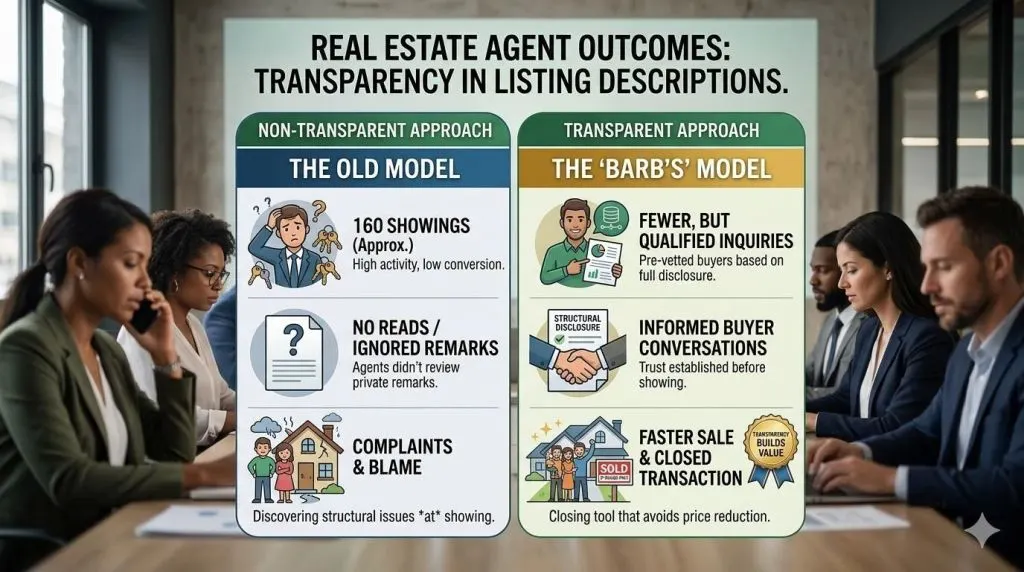
She was marketing a VA-owned foreclosure property with known structural issues. The home was priced $100,000 below comparable sales. She included the details in the private agent’s remarks. She even added a link to show time so agents could access all the data with one click. Out of 160 showings, almost none of the agents had read any of it.
Buyers were showing up, discovering the issues in person, and blaming Barbara for wasting their time. The agents were throwing her under the bus instead of admitting they had done zero research. When she tried to add the structural details to the public MLS description, the MLS stripped the language out because it contained the word “VA”, even though the VA was simply the owner.
The solution?
She used an alternative MLS to publish the full, transparent description where consumers could see it. The result surprised her. She got more buyer calls, more informed inquiries, and the home sold without a price reduction.
The lesson is powerful: when you are selling a home, transparency is not a liability but a closing tool!
What Changed for Me After This Conversation
After talking with Barbara, I see even more clearly that the agents who’ll survive and thrive are the ones who build systems, not the ones who chase. Her entire career is proof that when you invest in direct response marketing, build a brand consumers can remember, and show up with real data—not just promises—you become the Colorado Springs real estate agent everyone calls first.
One line from our conversation has stayed with me more than any other:
“The industry has really failed at articulating the real value that a really good real estate agent brings to the table. Unfortunately, Zillow, Realtor.com, and a lot of consumers think that real estate agents are overpaid door openers.”
What I also took away is how broken parts of this industry still are: agents who’ll not read MLS descriptions; inspectors who are not licensed; and associations that fine you for being transparent. Barbara pushes through all of it because her systems are stronger than the obstacles.
And that is what I want every agent who is buying a house in Colorado Springs, or selling one anywhere, to understand.Want to hear my full conversation with Barbara Schlinker of Barb Has the Buyers on achieving success as a real estate agent?
Frequently Asked Questions
What is direct response marketing in real estate?
Direct response marketing is a strategy where agents create offers that solve a specific consumer problem and include a clear call to action. You prompt buyers and sellers to reach out first.
How does the “Barb Has the Buyers” model work for sellers?
Barbara maintains a database of over 28,400 registered buyers. When she meets with a potential seller, she enters the home’s criteria into her system and produces a list of matched buyers on the spot. This gives sellers immediate proof of demand before the home is even listed.
Why is open house strategy important for getting top dollar?
Compressing buyer interest into a single open house event creates visible competition. When multiple buyers see each other in the home, they tend to offer higher prices to avoid losing out. Barbara regularly generates more visitors in a single hour and has sold homes over their asking prices using this seller listing agent marketing approach.
Apply as a Guest on the Real Estate Success DFW Podcast
Real estate is evolving. Marketing channels are shifting. Consumer expectations are rising. If you’re actively working in the industry and solving real problems—whether in production, marketing, brokerage leadership, or agent development—I want to hear from you!
Never miss an episode
Subscribe to Real Estate Success DFW on your favorite app. Have a story or strategy other agents should hear? Apply to be a guest.
More episodes
Why Kevin Yoder of Infinite U and Yoder Real Estate Stopped Recruiting and Built a More Profitable Team
Why did Kevin Yoder of Infinite U and Yoder Real Estate stop recruiting? Learn how SOPs, AI, and sharper sales skills beat more leads and bigger teams.

The Brokerage Myth I Unpacked With Devin Dubuc of Mortgage Coaching on Loan Officer Success Live
A better split won't fix a slow pipeline. Get the review and follow-up systems shared on Loan Officer Success Live with Devin Dubuc Mortgage Coaching.

What Geoff Cavender of The Cavender Team Knows About Leads That Most Agents Miss
Paid leads rarely fail on their own. Geoff Cavender of The Cavender Team shares the follow-up system and delegation plan behind 450 deals. Learn how.